
The complete guide for financial advisors
YouTube marketing for financial advisors, start to first client
YouTube works for financial advisors when it answers the questions your ideal clients already ask, in plain language, before they ever book a call. This guide covers the whole system. Who the channel is for, which videos to make first, how to title and script them, how compliance review fits in, and how a video library turns into first meetings that feel like second ones.

 Most first meetings now start at a kitchen table, before you are in the room.
In this guide
- Does YouTube work for advisors?
- Who your channel is for
- The first videos to make
- Finding topics people search
- Titles and thumbnails
- Scripts that hold attention
- Filming without losing a week
- Compliance rules
- YouTube Shorts
- Turning viewers into clients
- YouTube SEO for advisors
- How long it takes
- Why channels stall
- Do it yourself or hire help
- Questions advisors ask
Does YouTube actually work for financial advisors?
Yes, when the goal is trust and first meetings rather than views. A financial advisor does not need a big channel. A few hundred of the right people watching you explain the things they worry about is enough to change who calls you and how those calls go.
The way people hire an advisor has changed, even when the introduction still comes from a referral. Someone hears your name from a client, a CPA, or a friend at church. Then, before they reach out, they look you up. In a 2025 survey of 500 U.S. adults earning over $100,000 who plan to hire an advisor, Wealthtender found that 96% will research an advisor online before making a decision. The same share said they would still research an advisor who came highly recommended.
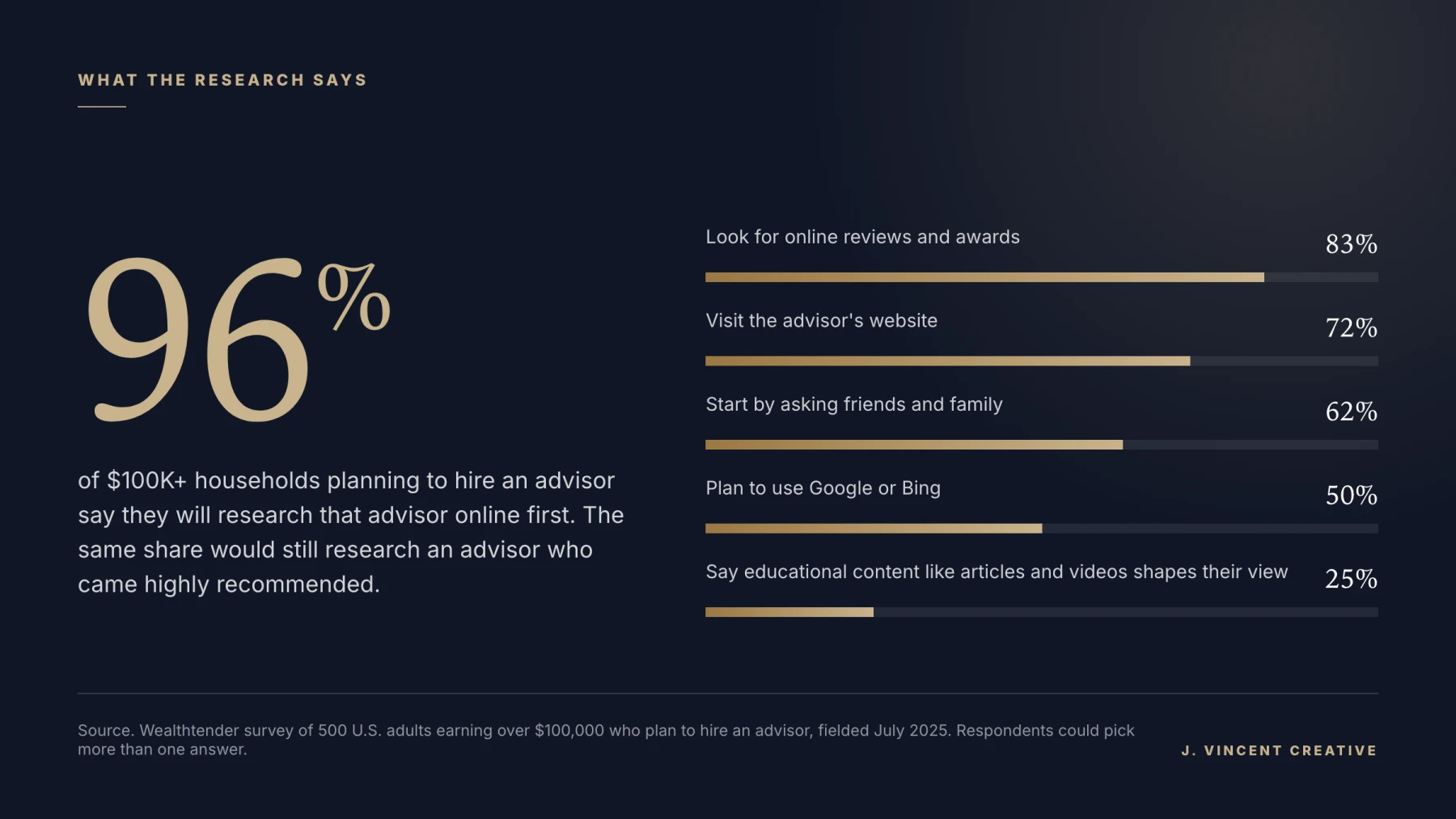
So the real question is what they find when they look. For most advisors it is a firm bio page, a LinkedIn profile, and a headshot. None of that lets a prospect hear how you think. A video does. Ten minutes of you calmly explaining a Roth conversion or how you charge tells a prospect more about whether they would trust you than any credential on your wall.
That is the job of an advisor's YouTube channel. It is the first meeting before the first meeting.
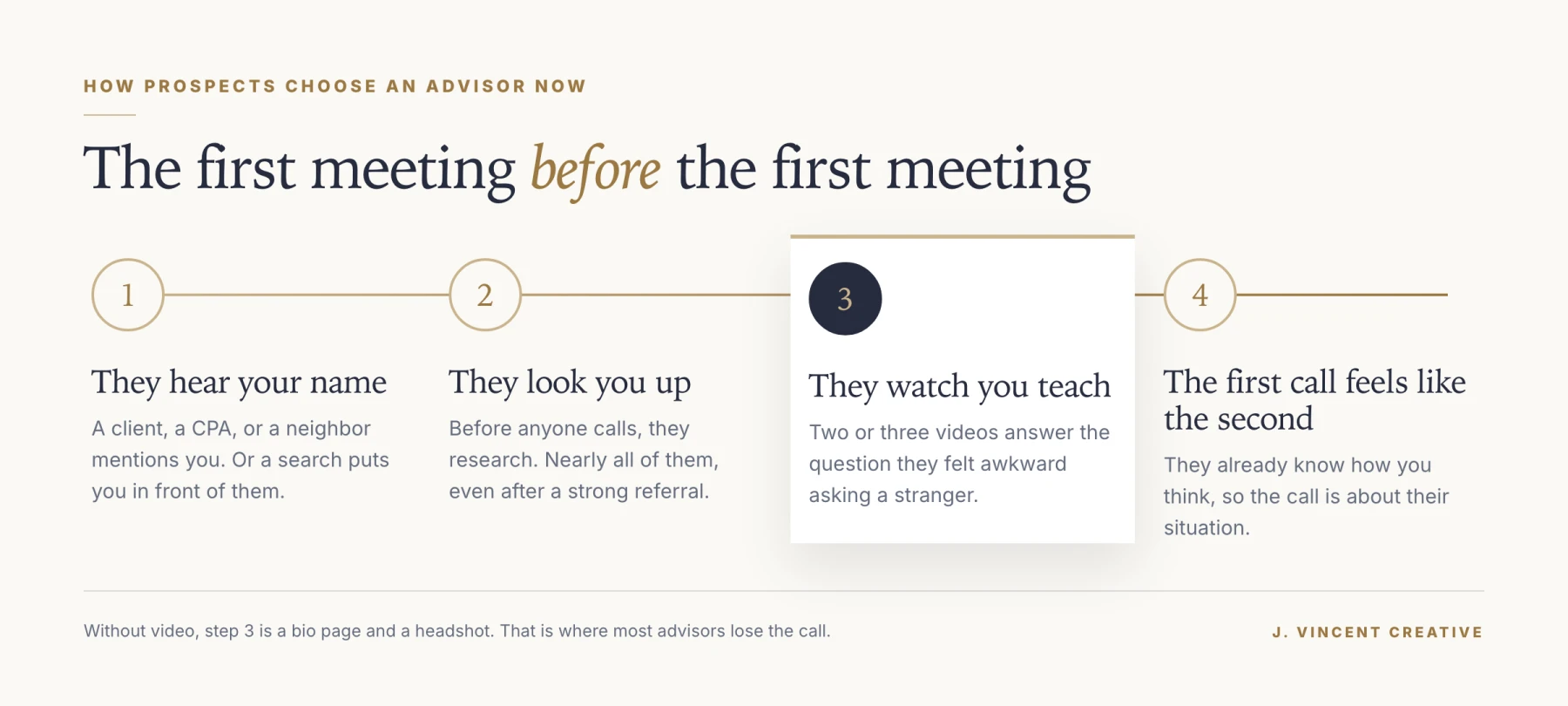
I learned this about my own business before I ever said it to a client. When someone was referred to me and pointed to my YouTube and LinkedIn first, the call was easy. They already knew what I did and how I thought. We spent the time on their situation.
When the call came from a cold message, it often opened with "I don't even know why I'm on this call. What do you do again?" Same person on my end. Completely different first meeting. The only thing that changed was whether they had seen me before we talked.
There is a second reason YouTube works for advisors, and it is easy to miss. Video re-introduces you to people who already know you. Former coworkers, parents from your kids' teams, the couple from small group. They know you as a person. Seeing you explain retirement income every week is what makes them think of you as the person to call about their money.
Who should your channel be for?
The most common reason an advisor channel never gets traction is that it is made for everyone. "Investors" is not an audience. Neither is "people who want to retire comfortably." YouTube rewards channels that a specific viewer can recognize as being for them within a few seconds.
Start with the clients you already serve best and would happily clone. Then describe them in one sentence that names their stage of life and the moment they are in.
- Pre-retirees five to ten years out who have saved well and are not sure it adds up to a paycheck.
- Business owners thinking about selling or handing off the company in the next few years.
- Physicians and dentists who started earning late, carry debt, and have little time to think about any of it.
- Federal employees trying to make sense of FERS, TSP, and a pension decision.
- Widows and divorcees suddenly making the decisions a spouse used to handle.
- Families in your town who would rather sit across from someone local.
You can serve more than one of these. Your channel should lead with one. When a pre-retiree in Alpharetta finds a video titled for pre-retirees, from an advisor who mentions Georgia taxes and North Fulton, the video feels like it was made for them. That feeling is what earns the click, the watch, and later the call.
A quick test. Read your last five video titles to one of your best clients. If they would not say "that's me" about at least three of them, the channel is still talking to everyone.
One more thing about audience. Make the video about the viewer, not about you. Prospects do not want your process, your awards, or your firm's history first. They want to see their own situation explained by someone who clearly understands it. The advisor is the guide in the video, never the subject. A useful check is to count how often your script says "you" compared with "I" or "we." Aim for three to one.
What videos should a financial advisor make first?
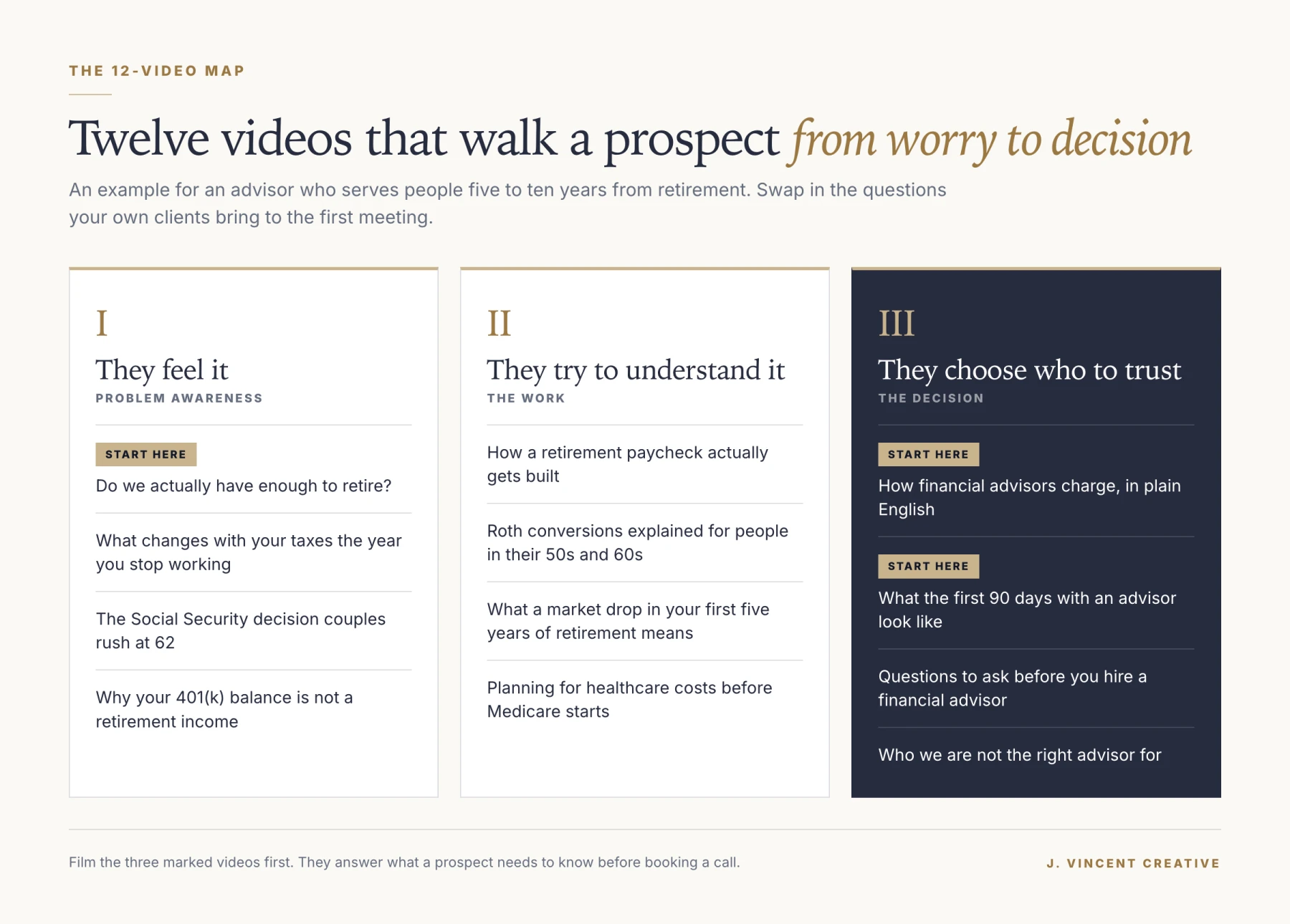
Make the videos a prospect needs before they are willing to book a call. In practice that means mapping videos to the three stages a person moves through on the way to hiring you.
- They feel it. Something is nagging at them. Do we have enough? What happens to our taxes? Did we wait too long?
- They try to understand it. They start learning how the pieces work. Roth conversions, Social Security timing, how a portfolio turns into income.
- They choose who to trust. They compare advisors. How do you charge? What is it like to work with you? Are you right for someone like them?
Four videos per stage gives you twelve, which is roughly three months of weekly publishing and a library that can carry a prospect from worry all the way to a decision.
The three to film first
If you only make three videos this quarter, make these.
- The question you get asked most. For most advisors it is some version of "do we have enough to retire." Answer it the way you would across a table, with the honest "it depends" and what it depends on.
- How you charge, in plain English. Fee-only, fee-based, assets under management, flat fee, or commission. Prospects who understand your pricing before the call do not flinch at it during the call. Use the exact language your firm is registered to use.
- What the first 90 days look like. Who they meet, what they bring, what happens in each meeting, and what they walk away with. This one video removes most of the fear of the first call.
Notice that two of those three sit in the decision stage. That is on purpose. These are the videos you will send people who already heard your name, and they convert faster than anything else you make.
How do you find video topics people actually search for?
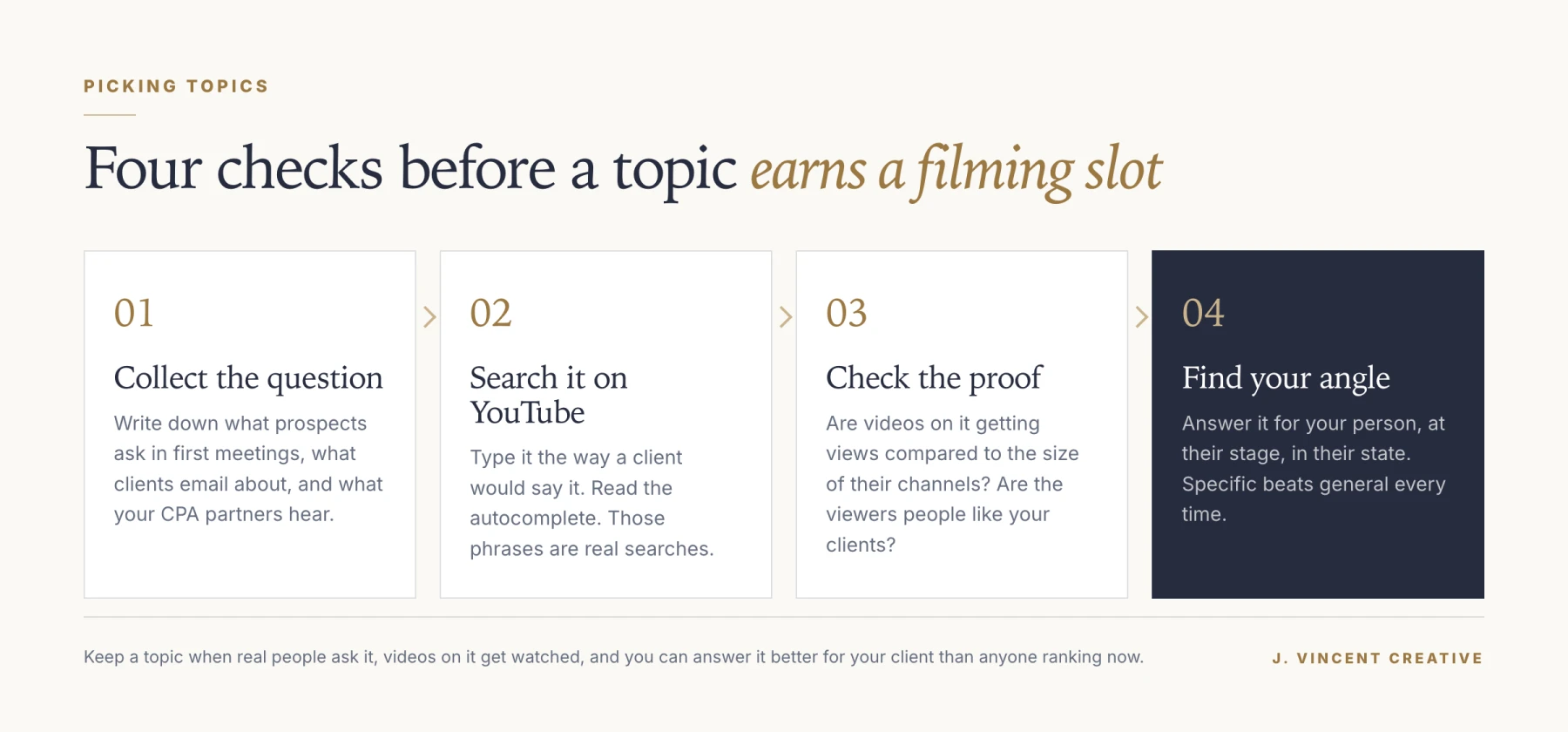
The best topics are already in your calendar. Every question a prospect asks in a first meeting, every email a client sends after a market drop, and every "quick question" at a cookout is a video idea. Start a running list and add to it every week.
Then check each question against real demand before you film it. Guessing is how advisors end up with forty videos nobody watched.
How to check demand in ten minutes
- Type the question into YouTube the way a client would say it. Watch the autocomplete suggestions. Those are phrases real people searched.
- Look at the top results. Note how many views each video has compared with the size of the channel. A video with 80,000 views on a channel with 4,000 subscribers is proof the topic pulls viewers on its own.
- Check who those videos serve. If the results are aimed at day traders or 25-year-olds, the phrase may be right but the audience is wrong. Find the version your clients would type.
- Decide your angle. You will rarely be the first to cover a topic. You can be the first to cover it for retired teachers in Georgia, or for a couple selling a dental practice.
Good sources for questions beyond your own meetings include the Reddit communities where people talk about retirement and personal finance, the comment sections under popular finance videos, and your CPA and estate attorney partners. Ask them what their clients keep asking about money. They will have a list.
Seasonal topics worth planning for
- Fall and year end. Required minimum distributions, Roth conversions, tax-loss harvesting, open enrollment and Medicare.
- Winter. New contribution limits, what changed this year, and tax-season questions.
- Spring. Tax deadline questions, then the "we just finished our taxes, now what" window.
- Any time markets move. A calm, educational video on what a drop means for someone in or near retirement, without predictions.
How do you title and thumbnail a financial advisor video?
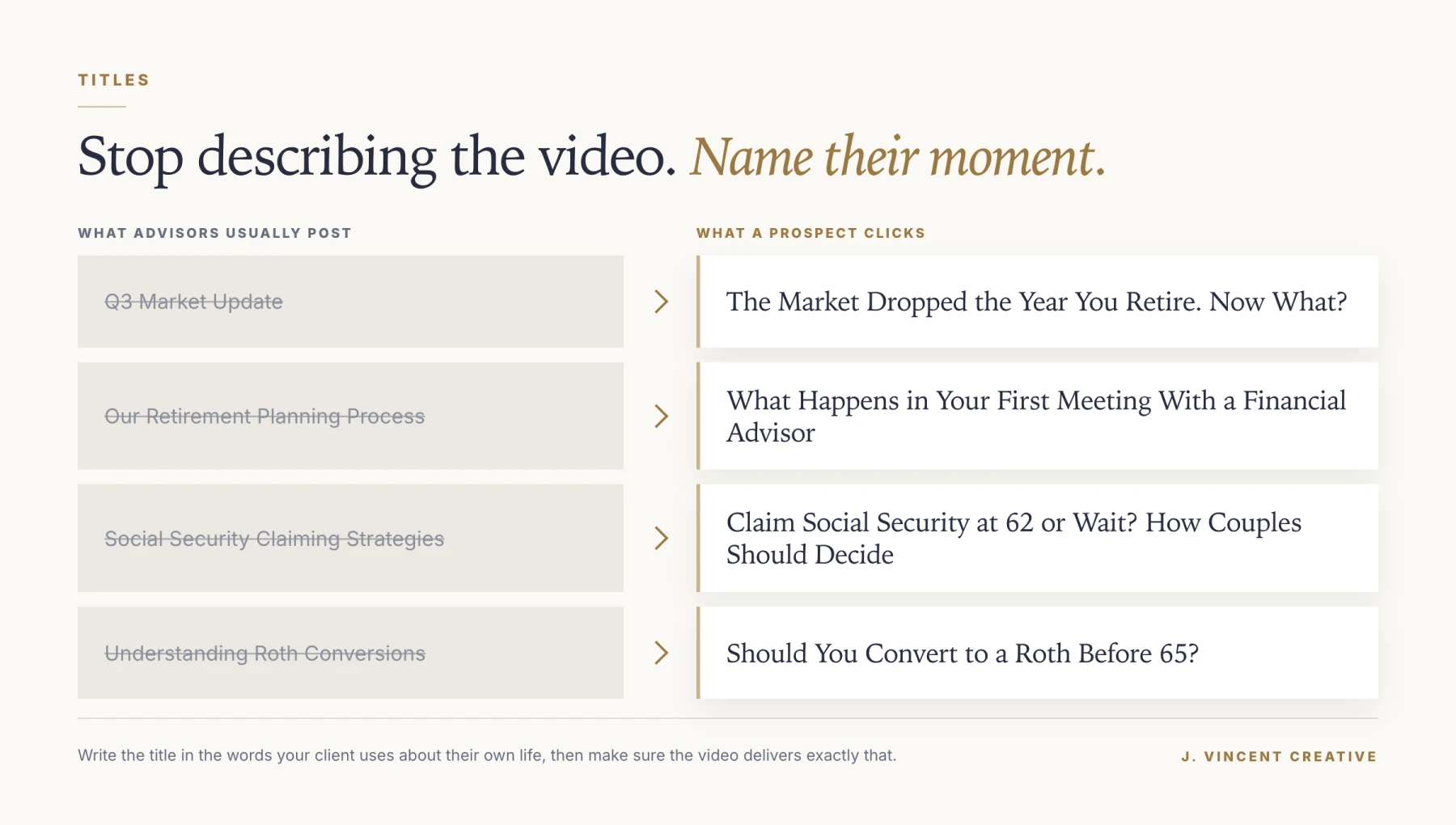
Packaging comes before the script. If nobody clicks, it does not matter how good the video is. Most advisor channels lose here because they describe the video instead of naming the viewer's moment.
Title rules that hold up
- Use the client's words, not industry words. People search "when can I retire," not "retirement readiness assessment."
- Name the person or the moment. "For couples in their 60s." "The year you retire." "Before you sell your business."
- Keep it under about 60 characters so it does not get cut off on a phone.
- Make a promise the video keeps in the first 30 seconds. A title that oversells hurts watch time and trust at the same time.
- Stay inside compliance. No guaranteed outcomes, no return figures, no "risk-free," and nothing that sounds like a recommendation for a specific product. Titles and thumbnails are part of the communication and get reviewed like everything else.
Thumbnails for advisors
A good advisor thumbnail is simple. Your face, looking engaged rather than posed, a clean background, and three or four words that add to the title instead of repeating it. If the title is "Claim Social Security at 62 or Wait?" the thumbnail text might be "62 or 70" with a real expression of thought. Check every thumbnail at the size of a postage stamp, because that is how most people will see it on a phone.
Use a real frame or photo from that day's shoot. Stock photos and look-alike images break the one thing a thumbnail is supposed to do, which is introduce the actual person the viewer would be working with.
How do you script a video that keeps people watching?
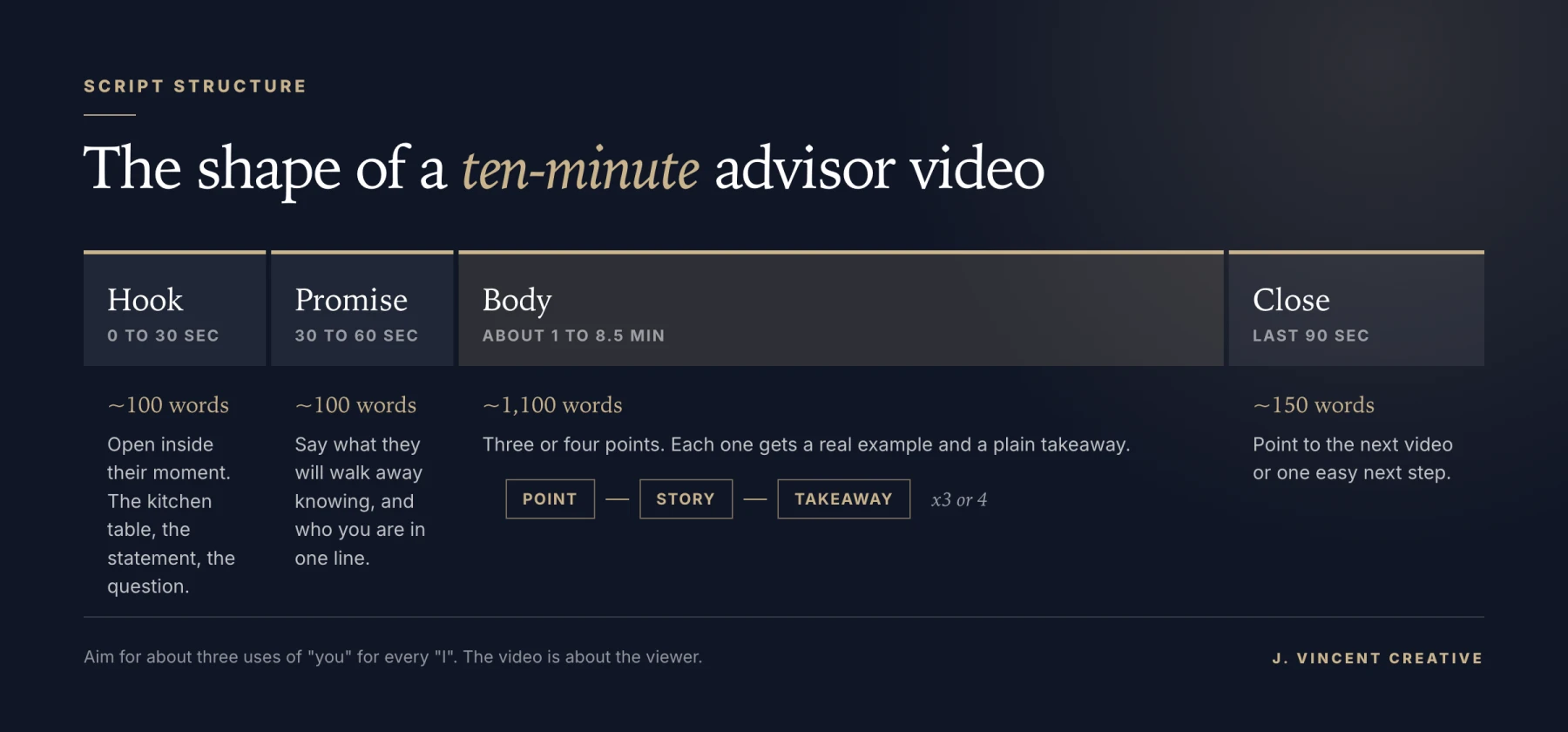
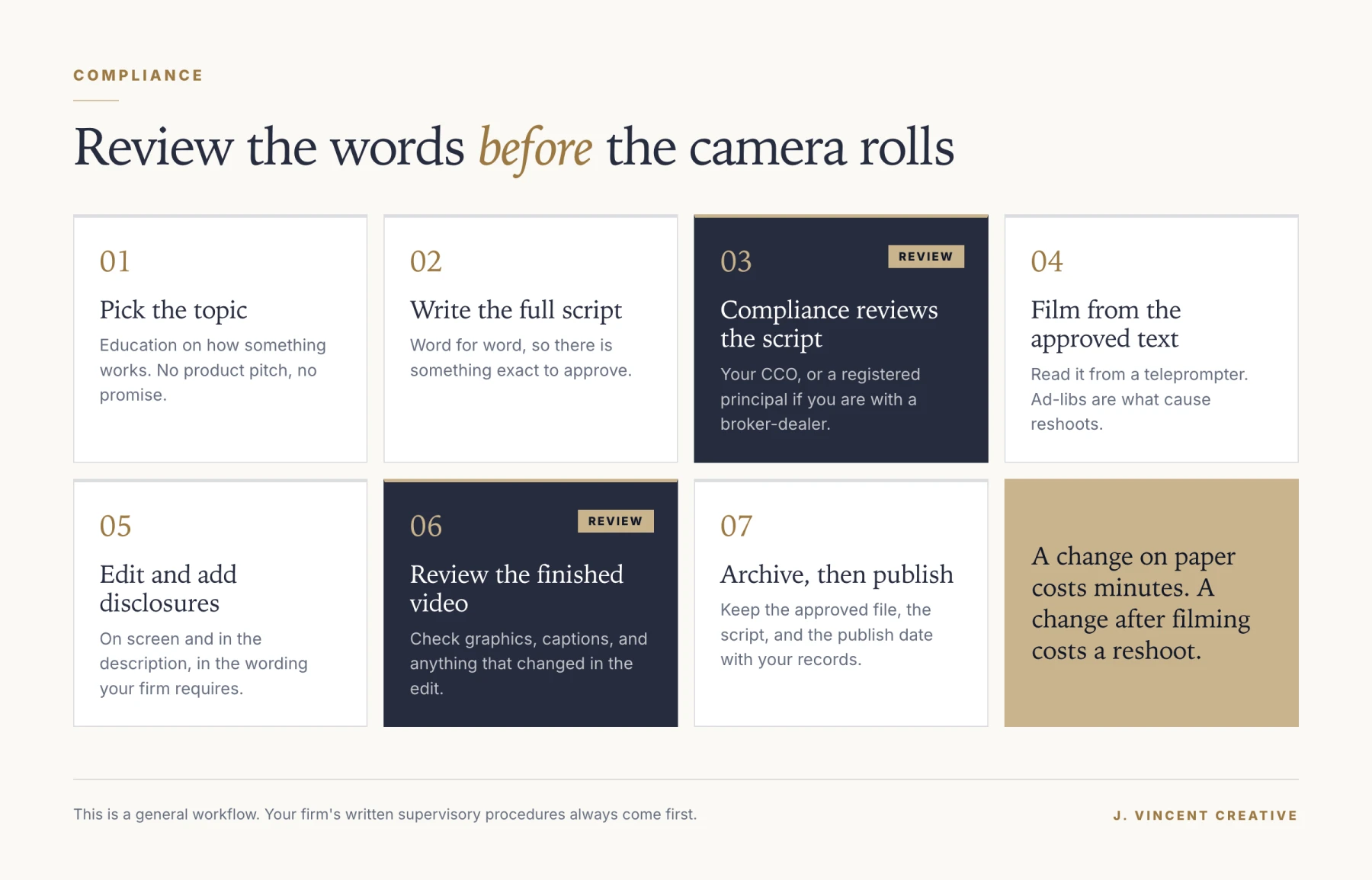
Write it word for word. Advisors who "just talk" wander, repeat themselves, and say things their compliance team would have caught on paper. A full script fixes all three. It also makes review easy, because your CCO approves exact text instead of a rough idea.
The hook
Open inside the viewer's moment. Not with your name, your firm, or "in today's video." Start where they are. "You just looked at your 401(k) statement and did the math on a napkin, and you're not sure if the number is a lot or a little." That line tells the right person they are in the right place, and it does it in about five seconds.
The promise
Tell them what they will walk away knowing, then introduce yourself in one line. "By the end of this you'll know the three numbers that actually decide when you can retire. I'm Sarah Mitchell, I'm a financial planner in Charlotte, and this is the conversation I have with couples every week." Keep the introduction short. They clicked for the answer.
The body
Three or four points, each built the same way. Make the point. Tell a real example, anonymized and approved, or a clear hypothetical. Then give the takeaway in one plain sentence. Stories are what people remember and repeat. Facts without a story slide right off.
The close
End with the next helpful step for the viewer. Usually that is the next video in the series, which keeps them watching and keeps them learning from you. Sometimes it is a soft invitation to reach out if their situation sounds like the one you described. Never a hard pitch. The trust you just built is worth more than one more ask.
Add the educational line early. For any topic that touches investments, taxes, or products, say something like "this is general education, not advice for your situation" within the first minute or so, and use the exact disclosure language your firm requires on screen and in the description.
How do you film without losing a week every month?
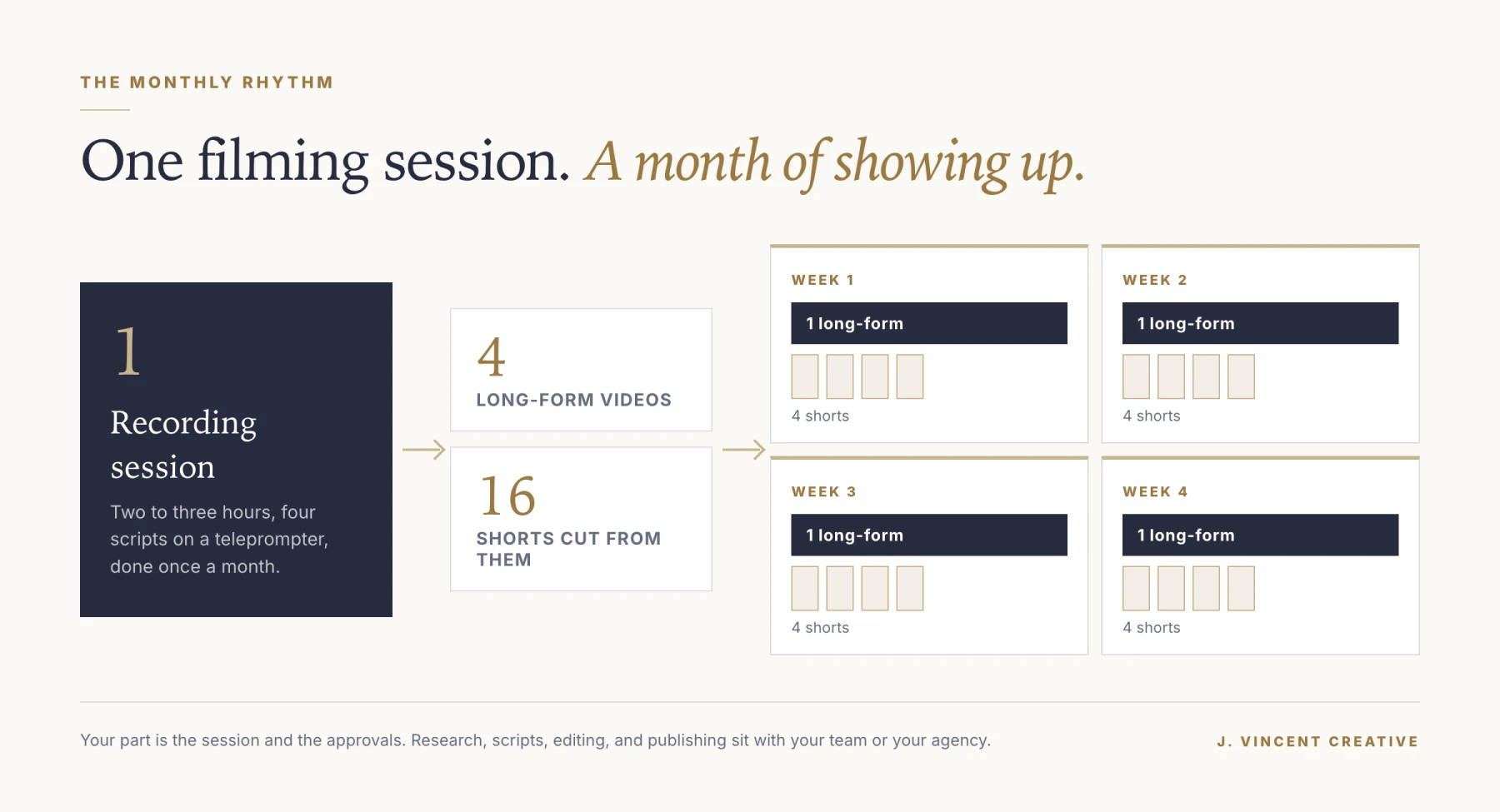
Batch it. The advisors who keep going are the ones who film once a month and never think about the camera the rest of the time. One focused session of two to three hours with four approved scripts on a teleprompter gives you a month of long-form videos, and the shorts are cut from the same footage.
What you actually need
- Good audio first. People forgive soft video. They click away from echo and hiss. A lavalier or a shotgun microphone placed close is the single best upgrade.
- Soft light from the front. One large soft light at a slight angle, plus window light if you have it. Avoid sitting with a window behind you.
- A camera that holds focus. A recent smartphone works to start. A mirrorless camera on a tripod looks noticeably better for long sessions.
- A teleprompter. It lets you deliver a reviewed script while still looking at the viewer. An inexpensive tablet prompter is enough.
- A real room. Your office with some depth behind you looks more trustworthy than a blank wall or a green screen.
Delivery tips that help on camera
Talk to one person. Picture a specific client across the table and explain it to them. Slow down about 10 percent from how you speak in meetings, because the camera flattens energy. And do a second take of your hook every time. The first 30 seconds decide whether anyone stays, so they are worth an extra minute.
The rest of the work, from research and scripting to editing, captions, graphics, thumbnails, and publishing, should sit with someone else. Editing is the step that quietly kills advisor channels. It takes hours, and an advisor's hours are worth far more in front of clients.
What are the compliance rules for financial advisor YouTube videos?
Compliance is a workflow, not a reason to stay off camera. The rules depend on how you are registered, and your firm's written procedures always have the final word. Here is how the main rules apply to video as of October 2026.
The SEC Marketing Rule
Rule 206(4)-1 under the Advisers Act governs advertisements. A video that names your firm and invites viewers to reach out will usually be treated as one. Claims need substantiation, benefits need balanced risks, and performance has strict conditions.
FINRA Rule 2210
A video seen by more than 25 retail investors within 30 days is generally a retail communication. Static content, like a prerecorded video, typically needs approval by a registered principal before use.
Recordkeeping
Keep the approved script, the final video, the disclosures used, and the publish date. Both SEC and FINRA rules require advertisements and communications to be retained for several years.
Both sets of rules
If you are dually registered, expect both the Marketing Rule and FINRA review to apply. Your broker-dealer's process usually sets the pace.
Testimonials and client stories
Since the Marketing Rule took effect, RIAs can use testimonials and endorsements, but only with clear and prominent disclosures about whether the person is a client, whether they were paid, and any material conflicts. In December 2025 the SEC's Division of Examinations issued another risk alert on testimonials, endorsements, and third-party ratings, and missing disclosures were among the most common problems it found. If a client appears in a video or a story is clearly about one person, treat it as a testimonial and run it through compliance. Anonymized, composite, or hypothetical examples are simpler.
Comments
What viewers write in the comments is generally treated as their content, not yours. That changes if you adopt it. Liking, pinning, or replying "thank you, we loved working with you" to a glowing comment can turn it into your testimonial. Many firms turn comments off on YouTube, hold them for review, or have a written policy for responding. Decide this with your CCO before you launch, not after the first nice comment.
What to avoid saying on camera
- Promises or guarantees of any outcome, including "you will be able to retire at 60."
- Return figures or performance claims that have not been through compliance.
- Recommendations of specific securities or products to a general audience.
- "Risk-free," "safe," or similar words about investments.
- Describing your compensation in terms your registration does not support. If you are fee-based, never say fee-only.
- Disparaging named competitors or firms.
A rule change to watch. In July 2026, FINRA published Regulatory Notice 26-14, a proposal to replace the blanket principal pre-approval requirement for retail communications with risk-based standards and to stop treating interactive and static social media differently. The comment period closed September 11, 2026. It is a proposal, not a rule, so keep following your current procedures until your firm tells you otherwise.
State-registered advisers answer to their state securities regulator, and many states follow rules similar to the SEC's. If that is you, your state's advertising rules apply in the same places described above.
Do YouTube Shorts work for financial advisors?
Yes, as commercials for your long-form videos rather than as a replacement for them. A short can be up to three minutes, but the ones that work for advisors are usually 30 to 60 seconds. One sharp idea, one moment the viewer recognizes, and a clear pointer to the full video where the real explanation lives.
Shorts reach people who have never heard of you. They rarely build enough trust on their own to produce a client. The long-form video is where a prospect spends ten minutes with you and decides you are someone they could work with. So every short should point somewhere, and that somewhere should be the full video.
- Write shorts as their own scripts. Random clips cut from the middle of a long video usually start without context and lose people in two seconds.
- Open with the viewer's moment. "If you are about to retire and the market just dropped" works. "So, as I was saying" does not.
- Use burned-in captions. Many people watch on mute.
- Post them everywhere. The same vertical video works on YouTube Shorts, Instagram, Facebook, and LinkedIn, which matters if your firm allows those platforms.
Shorts go through compliance the same way long-form videos do, including their captions and on-screen text.
How do you turn YouTube viewers into clients?
Most advisors publish a video and wait for strangers to find it. That works eventually. The faster path is to put each video in front of the people who already have your name and are deciding whether to call.
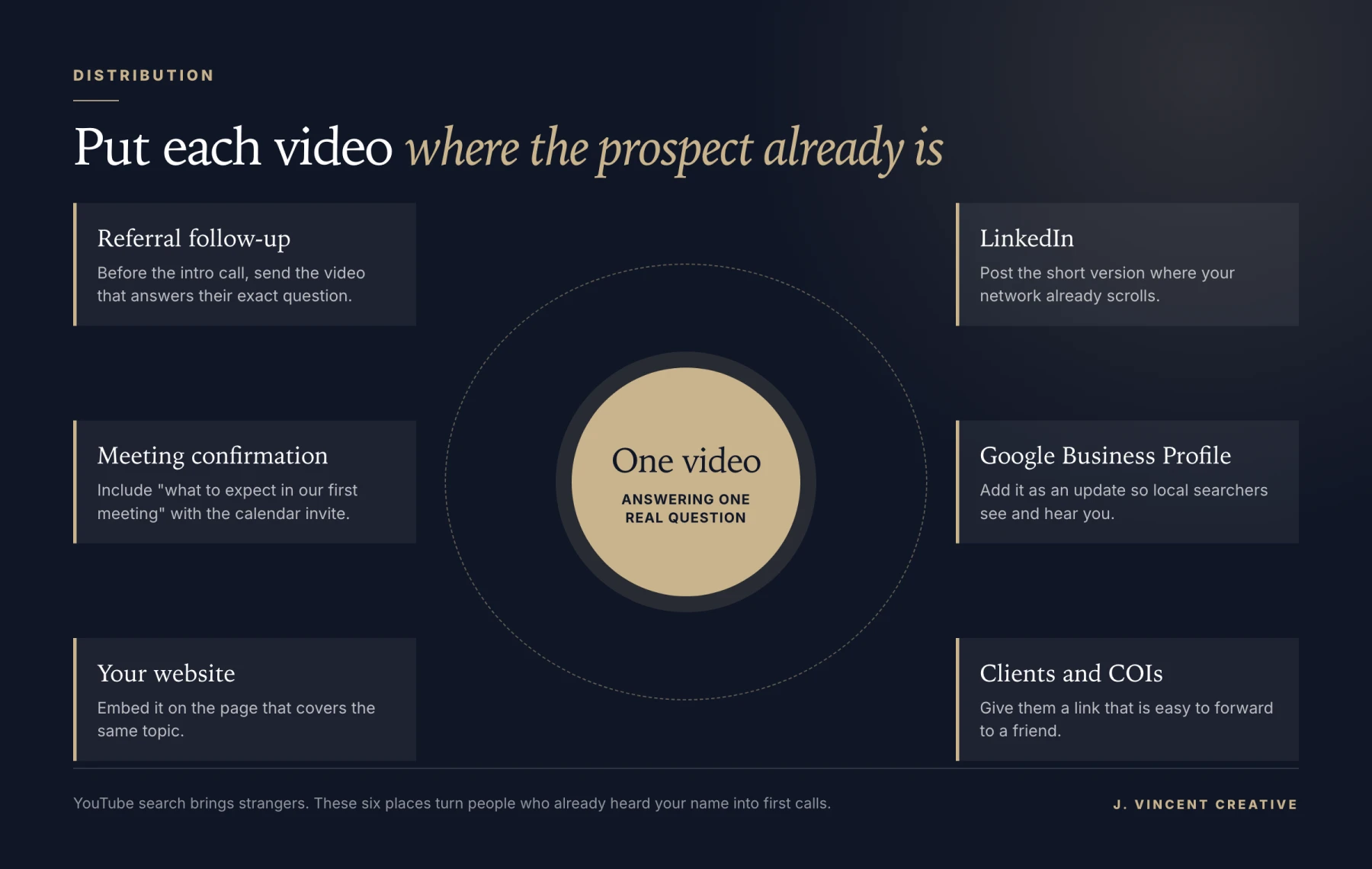
Use videos in the moments that matter
- After a referral. When a client introduces someone, reply with the video that answers that person's likely first question. "Before we talk, this might help."
- Before the first meeting. Send "what to expect in our first meeting" with the calendar invite. Prospects show up calmer, with the right documents, and with better questions.
- On your website. Embed each video on the page that covers the same topic. Your fee video belongs on your pricing or process page.
- With centers of influence. CPAs and estate attorneys refer more easily when they have something useful to send. A clear video on Roth conversions is easier to forward than your phone number.
- In your email newsletter. One video a week gives your list a reason to open and keeps you in mind for the moment they are ready.
Calls to action that do not feel like selling
Inside the video, the best call to action is usually the next video. Inside the description, add one simple next step, such as a link to your contact page or a free planning checklist. Keep the tone the same as the rest of the video. You are offering help, not chasing a meeting.
One fee-based advisor we film for in metro Atlanta received a message from someone in his professional network he had not spoken to in years. A high earner with a working spouse, income above contribution limits, and an inheritance in the picture. The message opened with praise for the videos and ended with a request to take over the family's finances.
No ads. No pitch. The videos had already done the introducing. You can read the full case study.
Brennan Decima, founder of Decima Wealth, on filming once a month
How do you optimize an advisor video for YouTube search?
YouTube search works mostly on what the viewer typed and how people respond to your video once they click. So the basics matter more than tricks. Every video should ship with the same complete package.
- A title that uses the phrase people search, in their words, inside about 60 characters.
- A description whose first two lines answer the question plainly, followed by a short summary, your required disclosures, and a link to your site. Mention your city or region if you serve clients locally.
- Chapters with clear labels, so viewers can jump to the part they need and YouTube can show those sections in search.
- Accurate captions. Upload a corrected caption file instead of relying on auto captions, which often mangle terms like IRMAA and RMD.
- A pinned comment or end screen that points to the next video in the series.
- Playlists by stage or topic, such as Social Security, retirement income, or working with an advisor, so one video leads naturally to the next.
- A custom thumbnail that passes the postage-stamp test.
Tags matter far less than most guides suggest. YouTube itself says they play a minimal role. Spend that time on the title and the first 30 seconds instead.
Your videos can also rank in Google, not just YouTube. Embedding each one on a relevant page of your website, with a few paragraphs of supporting text, gives Google a reason to show it for local and question searches. AI assistants increasingly cite video transcripts and pages that answer questions directly, which is one more reason to say the answer plainly and early.
How long does it take to get clients from YouTube?
Plan on a year. Most advisors who publish weekly start hearing "I watched your video" on first calls within the first few months, especially if they send videos to referrals. Search traffic from strangers takes longer to build, often six months or more, because YouTube needs time to learn who your videos are for.
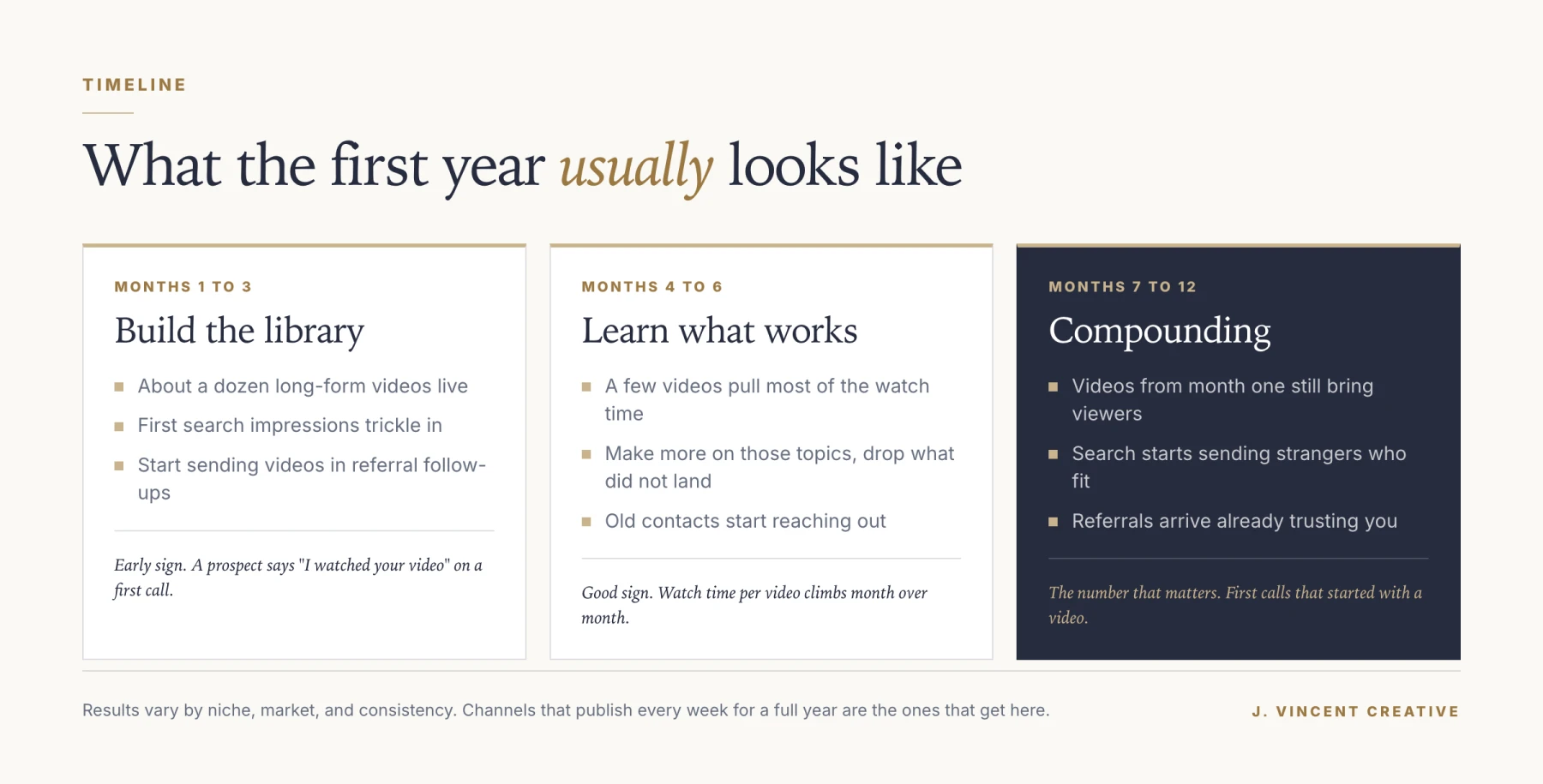
What to measure instead of views
An advisor channel with 900 subscribers can bring in more ideal clients than a finance entertainer with 900,000. Views are the wrong scoreboard. Track these instead.
- First calls that mention a video. Ask every new prospect how they found you and what they watched. This is the number that matters most.
- Watch time per video. Which topics hold people longest tells you what to make more of.
- Returning viewers. People who come back are the ones getting to know you.
- Click-through rate on thumbnails. If a good video is not getting clicked, the packaging needs work, not the content.
- Videos sent per month. How often you or your team used a video in a referral follow-up or meeting confirmation.
Why do most financial advisor YouTube channels stall?
The pattern is predictable. An advisor posts a burst of videos, gets a few nice comments from peers, sees low view counts, and quietly stops around month three. Usually the cause is one of these.
- The videos are about the advisor. Firm history, team introductions, and "our process" videos have their place, but they are not why a stranger clicks.
- The titles describe instead of connect. "Q3 Market Commentary" competes with every other advisor's market commentary and loses.
- There is no audience. A channel for everyone is a channel for no one in particular.
- Publishing is inconsistent. Four videos in January and none until May teaches YouTube nothing and teaches prospects that you might not be there either.
- The advisor is doing the editing. It is the slowest, least valuable use of an advisor's time and the most common reason channels stop.
- Compliance is an afterthought. Filming first and asking for approval later leads to reshoots, delays, and frustration on both sides.
- The videos never get used. A video that only lives on YouTube waits for strangers. A video sent to every referral works this week.
The channels that work are rarely the most polished. They are the ones that kept answering real questions, every week, for a year.
Watch. Why financial advisor YouTube channels fail in the first 10 videos. More on the J. Vincent Creative channel
Should you do it yourself or hire help?
It depends on how much time you have and what your time is worth in front of clients. Here is how the three common setups compare.
| Do it yourself | Freelance editor | Done-for-you agency | |
|---|---|---|---|
| Your time each month | Often 20 hours or more | About 8 to 12 hours | One filming session plus approvals |
| Topic research | You | You | Agency, with your input |
| Scripts | You | You | Written in your voice, you approve |
| Compliance prep | You | You | Scripts formatted for your CCO's review |
| Editing and graphics | You | Editor | Agency |
| Titles, thumbnails, SEO | You | Usually you | Agency |
| Shorts | Rarely happens | Sometimes | Included |
| Best for | Advisors who enjoy production and have time | Advisors who can plan and write but not edit | Advisors who want the result without becoming a media company |
If you go with an agency, look for one that knows the advisory world specifically. Ask how they handle compliance review, whether they write the scripts or expect you to, who directs the filming, and how they measure success. If the answer is views and subscribers alone, keep looking.
Questions advisors ask about YouTube
Is YouTube worth it for a financial advisor?
For most advisors who serve a clear type of client, yes. The value is not ad revenue or fame. It is that prospects can watch you explain their situation before they call, so first meetings start with trust. A small, well-targeted channel can be worth more than a large general one.
Can financial advisors legally post on YouTube?
Yes. RIAs follow the SEC Marketing Rule, registered representatives follow FINRA Rule 2210 and their broker-dealer's procedures, and state-registered advisers follow their state's rules. Educational videos reviewed by compliance before publishing are common and allowed. Your firm's written procedures decide the specifics.
Do financial advisor videos need compliance approval?
Usually. A YouTube video that promotes your services is generally an advertisement under the SEC Marketing Rule, and for registered reps a prerecorded video is typically a retail communication that needs principal approval before use. The easiest way to handle it is to have compliance review the full script before filming and the final video before it goes live.
How often should a financial advisor post on YouTube?
Once a week is the most sustainable rhythm that still builds momentum. Consistency matters more than volume. One video every week for a year beats a burst of ten videos followed by silence.
How long should a financial advisor YouTube video be?
Most advisor long-form videos land between 8 and 12 minutes, which is about 1,200 to 1,600 scripted words. That is long enough to explain a topic properly and short enough to hold a busy viewer. Shorts should usually be 30 to 60 seconds.
What should a financial advisor's first YouTube video be?
Answer the question you get asked most, usually some version of "do we have enough to retire." Then make a plain-English video on how you charge and one on what the first 90 days of working with you look like. Those three cover what a prospect needs before booking a call.
Can I use client testimonials in my YouTube videos?
RIAs can, under the SEC Marketing Rule, with clear and prominent disclosures about whether the person is a client, whether they were compensated, and any material conflicts. Registered reps have their own FINRA requirements. Always route testimonials through compliance first, and be careful about liking or pinning positive comments, which can turn them into your testimonial.
How much does YouTube marketing cost for a financial advisor?
Doing it yourself costs mostly time, plus a few hundred dollars of gear. Hiring a freelance editor adds a monthly editing fee. A done-for-you agency that handles research, scripts, filming direction, editing, shorts, and publishing costs more and saves the most time. Compare options by what you get per month and how much of your time each one gives back.
How many subscribers does an advisor channel need to get clients?
Far fewer than most people think. Advisors often get clients from channels with a few hundred subscribers, because the people watching are the right people and many of them were sent the video directly. Track first calls that mention a video rather than subscriber counts.
Jeff Evans
Jeff Evans is the founder of J. Vincent Creative, a YouTube video marketing agency in metro Atlanta for financial advisors and other professionals who sell on trust. He plans, scripts, directs, and produces educational video that helps prospects trust an advisor before the first call, and he is the person in the room on every client engagement.
This guide is general education about marketing. It is not legal, regulatory, or compliance advice. Rules change and their application depends on how you and your firm are registered. Confirm any approach with your chief compliance officer or broker-dealer before publishing. J. Vincent Creative is not a compliance consultant and does not replace your firm's review.
Want this done for you?
Film once a month. Let the videos make the introductions.
J. Vincent Creative researches the questions your ideal clients ask, writes the scripts in your voice for compliance review, directs one filming session, and delivers four long-form videos and sixteen shorts every month.
Book a channel strategy callOnsite in metro Atlanta or virtual anywhere in the country. No pressure, just a conversation about your clients and what they are asking.

Jeff Evans is the founder of J. Vincent Creative, a YouTube video marketing agency in metro Atlanta for financial advisors, attorneys, CPAs, and EOS Implementers. He plans, scripts, films, and produces educational video, video podcasts, and ghostwritten newsletters that help prospects trust a firm before the first call. Jeff has spent his career in search and video marketing for professional service firms, and he is the person in the room on every client engagement.