
The complete guide for attorneys
YouTube marketing for attorneys, from first video to signed client
YouTube works for law firms when it answers the questions people type late at night, in plain language, before they ever call a lawyer. This guide covers the whole system. Who the channel is for, which videos to make first, how to title and script them, how bar advertising rules fit in, and how a video library turns into consultations that feel like second meetings.

 Most consultations now start at a kitchen table, hours before anyone calls the firm.
In this guide
- Does YouTube work for lawyers?
- Who your channel is for
- The first videos to make
- Finding topics people search
- Titles and thumbnails
- Scripts that hold attention
- Filming around a court calendar
- Bar advertising rules
- YouTube Shorts
- Turning viewers into clients
- YouTube SEO for law firms
- How long it takes
- Why channels stall
- Do it yourself or hire help
- Questions attorneys ask
Does YouTube actually work for attorneys?
Yes, when the goal is trust and signed cases rather than views. A law firm does not need a big channel. A few hundred of the right people in your area watching you explain the problem they are scared about is enough to change who calls and how the consultation goes.
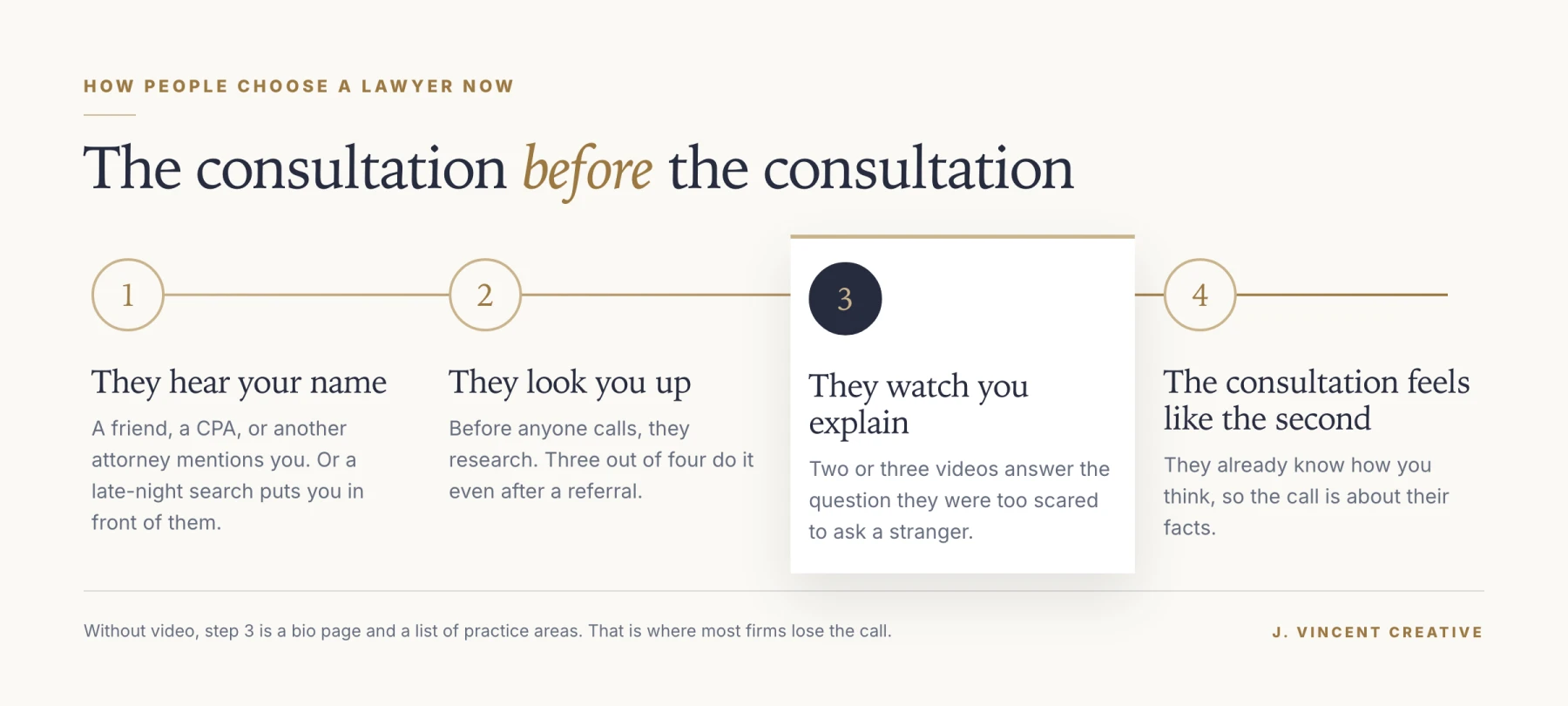
People still hire lawyers through referrals. What changed is what happens after the referral. Someone gets your name from a friend, a CPA, or another attorney. Then, before they call, they look you up. In Scorpion's 2025 survey of 3,000 U.S. adults, 75% said they would still check a lawyer out online before calling, even when referred. And 52% said they look for videos that explain a law firm's services before they decide.
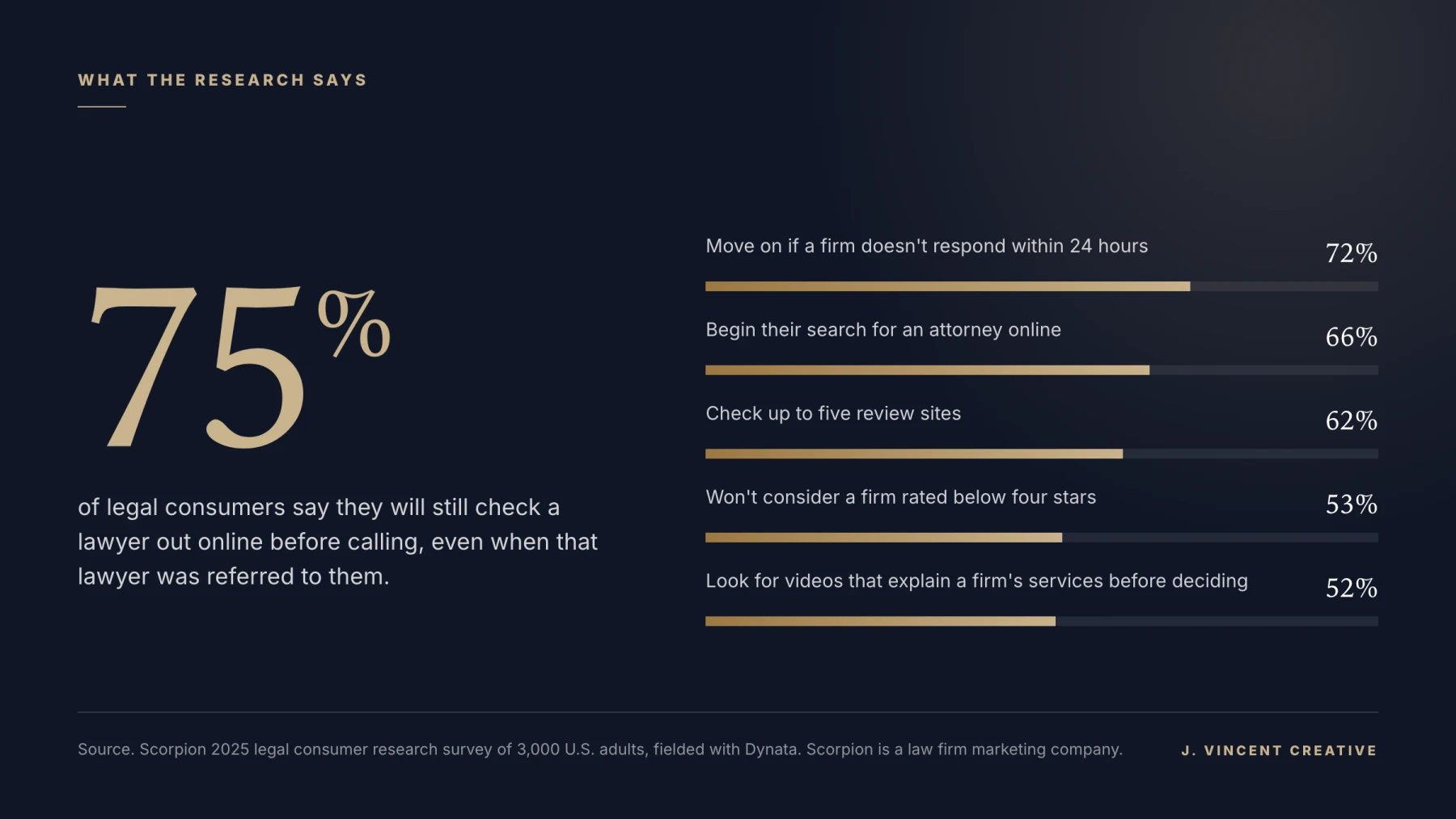
So the real question is what they find. For most attorneys it is a bio page, a headshot with crossed arms, and a list of practice areas. None of that lets a scared person hear how you explain things. A video does. Eight minutes of you calmly walking through what happens at a first court date tells a prospect more about whether they would trust you than any badge in your footer.
That is the job of a law firm's YouTube channel. It is the consultation before the consultation.
Anthonia Berry has spent 20 years in legal marketing and business development, including leadership roles at national and international firms. On my show she described what happened when she needed a corporate attorney herself. She was given a few names to research, so she went looking for what each of them had published.
"If they were talking about things that automatically answered some of the questions that I had, I already felt like they already had the answer." She had not paid anyone or booked anything yet. The videos had already done most of the deciding.
Something else is easy to miss with legal work. The person searching is often not the client. It is the mother whose son was arrested, the adult daughter sorting out a parent's estate, or the spouse who wants to understand a divorce before saying the word out loud. Video lets them hear you before anyone in the family has to make the call.
Video also re-introduces you to people who already know you. Former classmates, parents from your kids' teams, the couple from church. They know you as a person. Watching you explain what to do after a wreck is what makes them think of you when someone in their life gets hurt, served, or arrested.
Who should your firm's channel be for?
The most common reason a law firm channel never gets traction is that it covers every practice area for everyone. "People who need a lawyer" is not an audience. YouTube rewards channels that a specific viewer can recognize as being for them within a few seconds.
Start with the cases you most want more of. Then describe the person behind them in one sentence that names the moment they are in.
- Someone hurt in a wreck who just got the first call from an insurance adjuster.
- A parent whose teenager was arrested and who has never set foot in a courtroom.
- A spouse thinking about divorce who wants to know about the house and the kids before saying anything.
- Adult children handling a parent's estate, or trying to get a parent's plan in place before it is too late.
- A business owner about to sign a lease, take on a partner, or sell the company.
- Families in your county who would rather hire someone who knows the local courthouse.
A firm can serve several of these. The channel should lead with one. When a parent in Forsyth County finds a video about what happens after a juvenile arrest, from a lawyer who names the local court and explains the first hearing, the video feels made for them. That feeling earns the click, the watch, and later the call.
A quick test. Read your last five video titles to your intake person. If they would not say "people ask me that every week" about at least three of them, the channel is still talking to everyone.
Make every video about the viewer, not the firm. A prospect does not want your founding story, your verdicts, or the word "aggressive" first. They want to see their own situation explained by someone who clearly understands it. The lawyer is the guide in the video, never the subject. A useful check is to count how often your script says "you" compared with "I" or "we." Aim for three to one.
Anthonia Berry of Strategy Academy on picking a lane, referrals, and talking about pricing on video
What videos should a law firm make first?
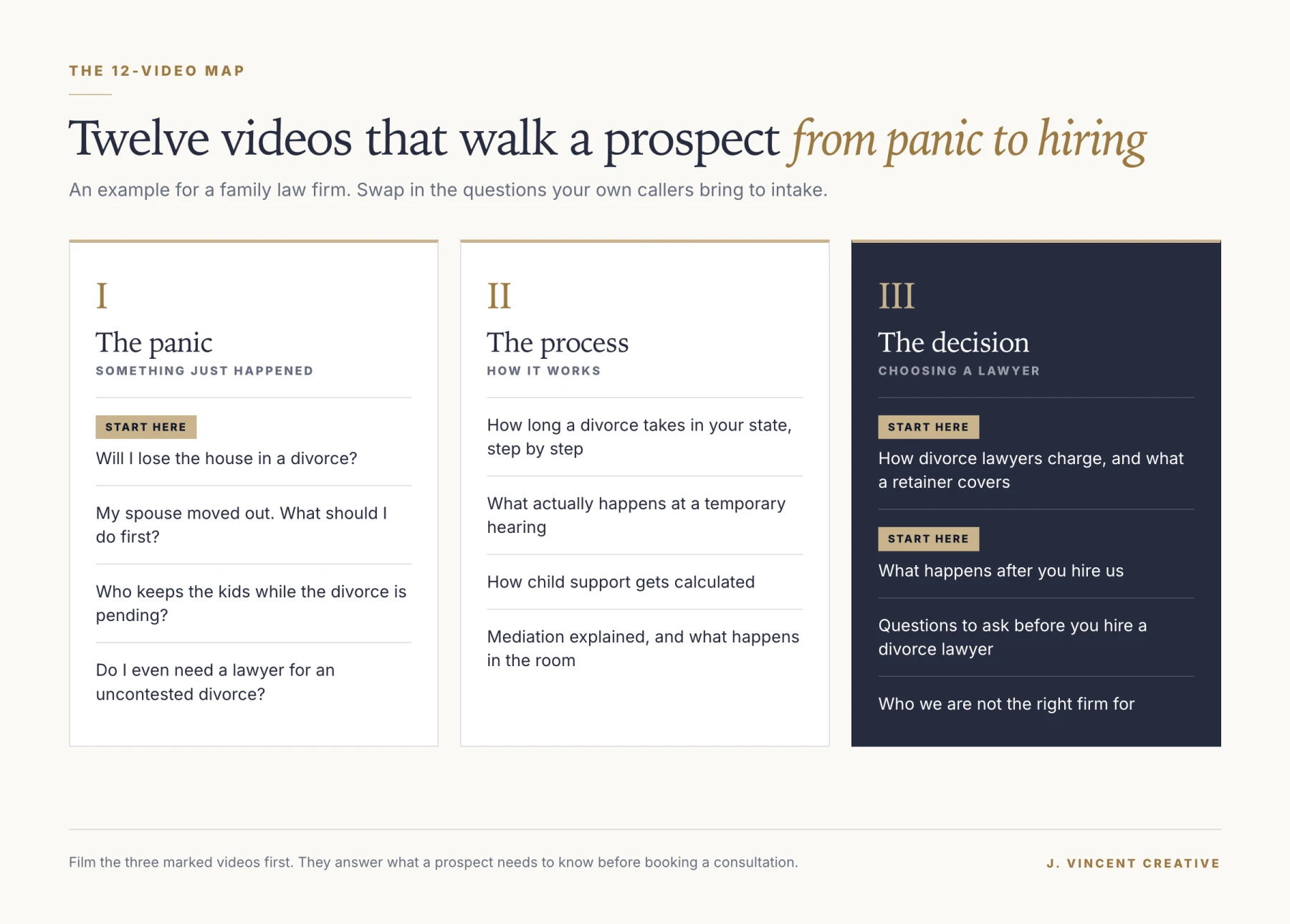
Make the videos a prospect needs before they are willing to pick up the phone. That means mapping videos to the three stages a person moves through on the way to hiring a lawyer.
- The panic. Something just happened. An arrest, a wreck, divorce papers, a death in the family. They want to know what happens next and what not to do.
- The process. They try to understand how it works. How long it takes, what each hearing is for, what the other side will do.
- The decision. They compare lawyers. How do you charge? What happens after they hire you? Are you the right firm for someone like them?
Four videos per stage gives you twelve, which is about three months of weekly publishing and a library that carries a prospect from fear all the way to a signed engagement letter.
The three to film first
If you only make three videos this quarter, make these.
- The question you answer at every intake. For a family lawyer it might be "will I lose the house." For a defense lawyer, "is this going on my record." Answer it the way you would in your office, with the honest "it depends" and what it depends on.
- How your fees work, in plain English. Contingency, flat fee, hourly, or retainer. A personal injury firm can explain exactly how it gets paid and what the client might still owe. A family law firm can give honest ranges and explain what moves a case from one end to the other. Prospects who understand your fees before the consultation do not go quiet when the engagement letter shows up.
- What happens after you hire us. Who they talk to, what happens in the first two weeks, how often they will hear from you, and how long each stage usually runs. This one video removes most of the fear of the first call.
Two of those three sit in the decision stage on purpose. These are the videos you send to people who already have your name, and they turn into consultations faster than anything else you make.
My family learned this the hard way choosing coaches for my son. When he was ten, he was put with football coaches who cursed at the kids, and he came home crying. We never asked a single question before he started.
Now we ask every coach the hard questions face to face. How do you teach? Do you yell? Is this about winning, or are you developing my son? Most of your prospects will never ask a lawyer the version of that. They are too polite or too scared to ask "what will this cost" and "what am I walking into." Your fee video and your process video ask it for them.
How do you find video topics people actually search for?
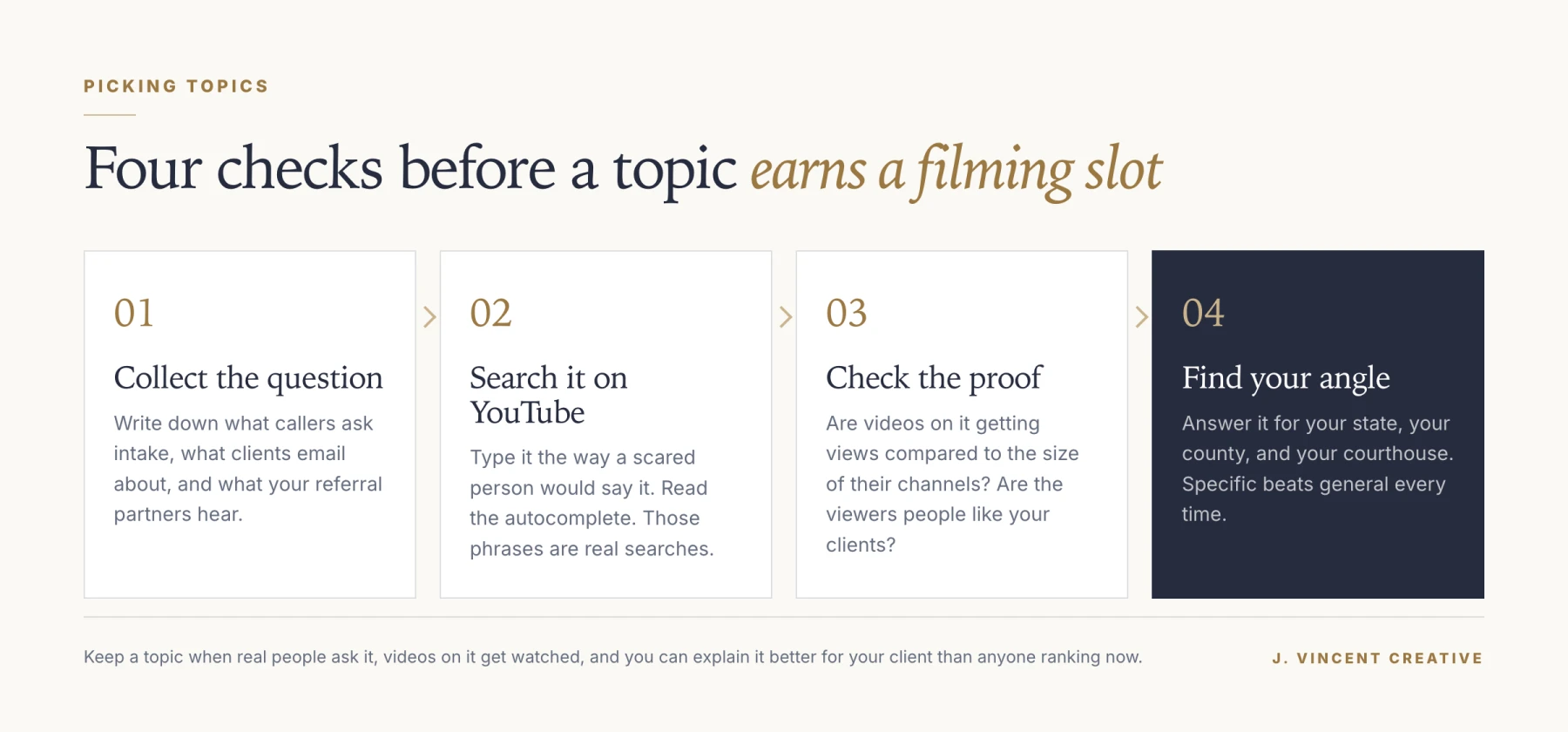
The best topics are already sitting in your intake notes. Every question a caller asks the front desk, every email a client sends at midnight, and every "quick legal question" at a birthday party is a video idea. Ask your intake team for the ten questions they answer most and start there.
Then check each question against real demand before you film it. Guessing is how firms end up with forty videos about statutes nobody searches for.
How to check demand in ten minutes
- Type the question into YouTube the way a scared person would say it. "What happens at an arraignment," not "arraignment procedure." Watch the autocomplete suggestions. Those are phrases real people searched.
- Look at the top results. Compare each video's views with the size of the channel. When we checked in October 2026, a small criminal defense firm with about 250 subscribers had an arraignment video with more than 53,000 views. A personal injury firm with about 660 subscribers had more than 57,000 views on "how long does a personal injury case take." That is proof the topic pulls viewers on its own.
- Check who those videos serve. If the top results are law students or a national audience, the phrase may be right but the viewer is wrong. Find the version your clients would type, often with your state or county in it.
- Decide your angle. You will rarely be the first to cover a topic. You can be the first to explain it for your courthouse, your county's process, or your state's specific deadlines.
Good sources beyond your own intake include the questions people post in public legal forums, the comment sections under popular legal videos, and your referral partners. Ask the CPAs, financial advisors, realtors, and counselors who send you clients what their people keep asking. They will have a list.
Timely topics worth planning for
- Law changes. When your state passes a new statute or a court changes a rule, a plain-English "what this means for you" video can be the first one people find.
- Busy seasons. Ask your intake team when calls spike. Holiday weekends for DUI defense, summer schedules for custody, year end for business owners and estate plans.
- Local news. A major wreck on a local highway or a policy change at the county jail brings searches. Explain the process, never the specific case.
- Deadlines. Filing windows and statutes of limitation are searched by people who are worried they waited too long.
How do you title and thumbnail a law firm video?
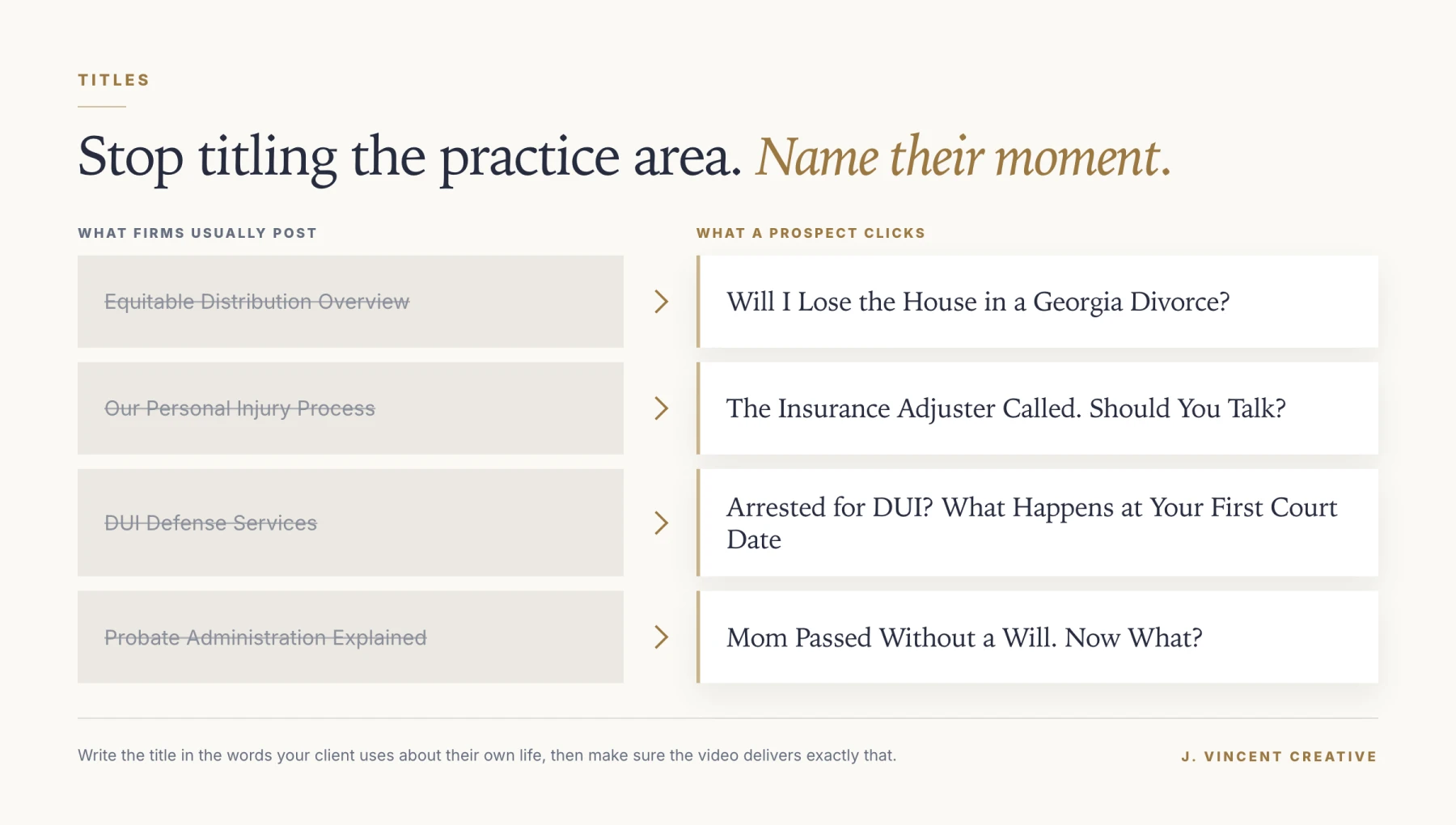
Packaging comes before the script. If nobody clicks, it does not matter how good the video is. Most law firm channels lose here because they title videos like practice area pages instead of naming the viewer's moment.
Title rules that hold up
- Use the client's words, not legal terms. People search "will I go to jail," not "sentencing exposure." Explain the legal term inside the video.
- Name the person or the moment. "After a wreck." "Before you sign." "If your spouse moved out."
- Add your state when the answer depends on it. Divorce, custody, probate, and criminal procedure all change at the state line, and searchers know it.
- Keep it under about 60 characters so it does not get cut off on a phone.
- Make a promise the video keeps in the first 30 seconds. A title that oversells hurts watch time and trust at the same time.
- Stay inside the advertising rules. No promised outcomes, no "we win," no case results without the context your state requires, and no "specialist" unless you hold a certification your state recognizes. Titles and thumbnails are part of the communication.
Thumbnails for attorneys
A good law firm thumbnail is simple. Your face, looking engaged rather than stern, a clean background, and three or four words that add to the title instead of repeating it. If the title is "Should You Talk to the Insurance Adjuster?" the thumbnail text might be "Not yet" with a real expression. Check every thumbnail at the size of a postage stamp, because that is how most people will see it on a phone.
Use a real frame or photo from that day's shoot. Skip the gavel, the scales of justice, and the stock courtroom. They make every firm look the same, and they hide the one thing a thumbnail is supposed to show, which is the actual person the viewer would be hiring.
How do you script a legal video that keeps people watching?
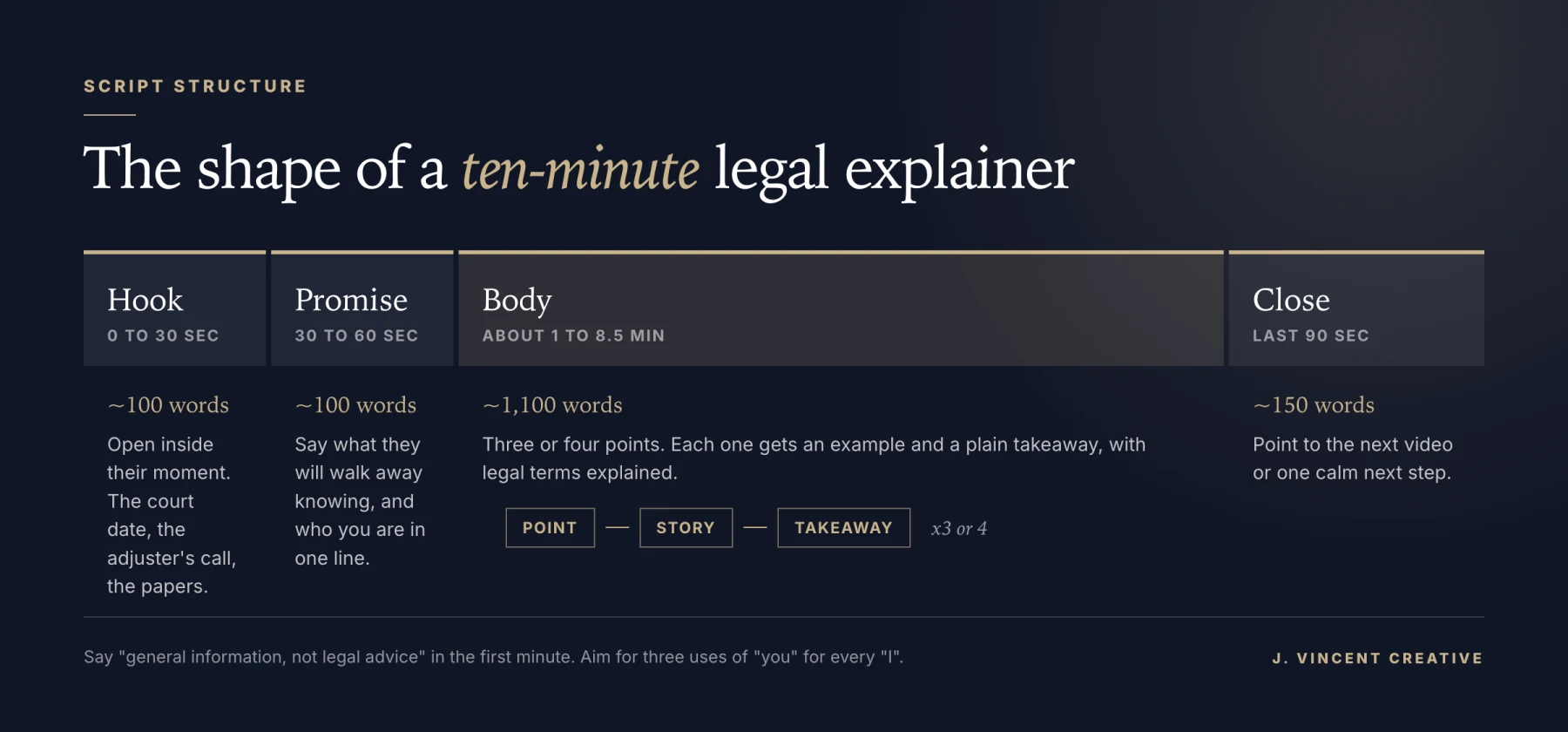
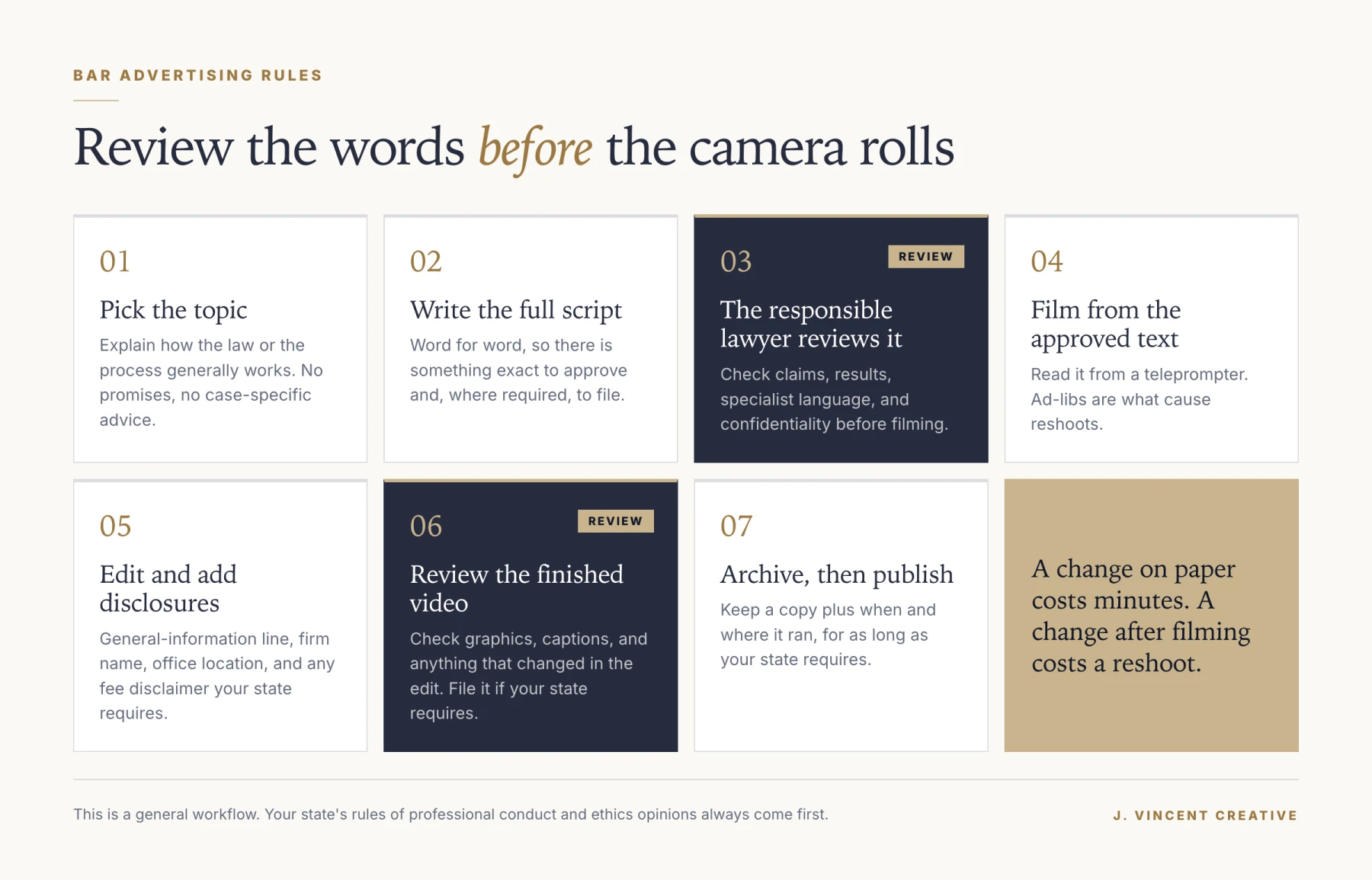
Write it word for word. Attorneys who "just talk" drift into legalese, wander into war stories, and say things the person handling ethics review would have caught on paper. A full script fixes all three. It also makes review easy, because the responsible lawyer approves exact text instead of a rough idea.
The hook
Open inside the viewer's moment. Not with your name, your firm, or "in today's video." Start where they are. "You're holding a court date on a piece of paper, and you have no idea what happens when you walk in that room." That line tells the right person they are in the right place, and it does it in about five seconds.
The promise
Tell them what they will walk away knowing, then introduce yourself in one line. "By the end of this you'll know exactly what happens at a first appearance and the one thing not to say. I'm Marcus Reed, I'm a criminal defense lawyer in Lawrenceville, and I walk families through this every week." Keep the introduction short. They clicked for the answer.
The body
Three or four points, each built the same way. Make the point. Tell an example, either a composite, a clear hypothetical, or a real matter the client has given written consent to discuss. Then give the takeaway in one plain sentence. Stories are what people remember and repeat. A list of statutes slides right off.
The close
End with the next helpful step for the viewer. Usually that is the next video in the series, which keeps them learning from you. Sometimes it is a calm invitation to call if their situation sounds like the one you described. Never a hard pitch, and never urgency you cannot back up. The trust you just built is worth more than one more ask.
Say the general-information line early. In the first minute or so, say something like "this is general information, not legal advice for your situation, and watching this doesn't make you my client." Put the same line on screen and in the description, along with whatever firm name, office location, and other details your state requires.
How do you film around a court calendar?
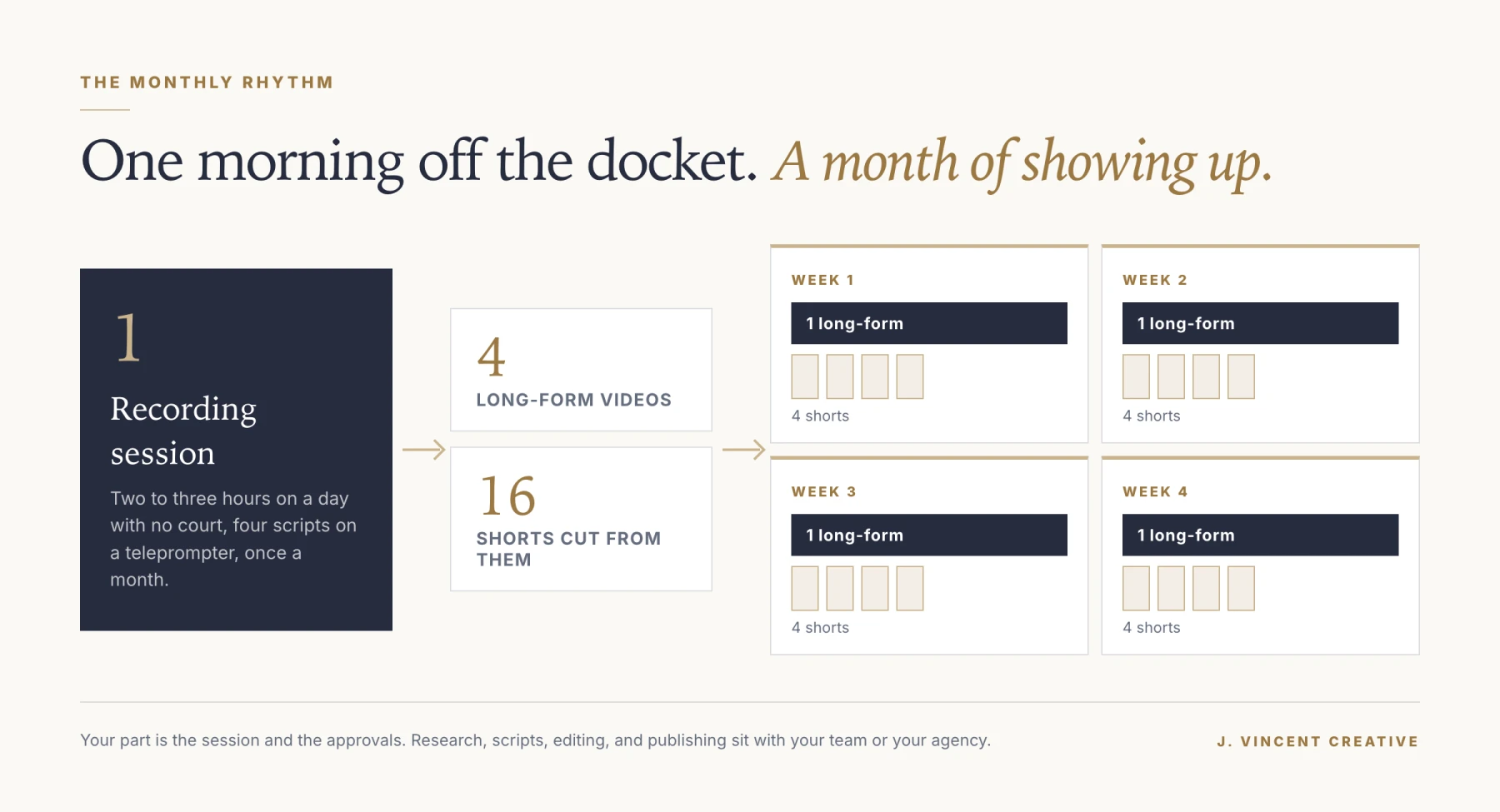
Batch it. Attorneys who keep going are the ones who block one morning a month, on a day with nothing on the docket, and never think about the camera the rest of the time. One focused session of two to three hours with four reviewed scripts on a teleprompter gives you a month of long-form videos, and the shorts are cut from the same footage.
What you actually need
- Good audio first. People forgive soft video. They click away from echo and hiss. A lavalier or a shotgun microphone placed close is the single best upgrade.
- Soft light from the front. One large soft light at a slight angle, plus window light if you have it. Avoid sitting with a window behind you.
- A camera that holds focus. A recent smartphone works to start. A mirrorless camera on a tripod looks noticeably better for long sessions.
- A teleprompter. It lets you deliver a reviewed script while still looking at the viewer. An inexpensive tablet prompter is enough.
- Your own office or conference room. A real room with some depth looks more trustworthy than a wall of law books or a green screen. Many courthouses restrict recording, so skip the courthouse steps unless you have confirmed it is allowed.
Delivery tips that help on camera
Talk to one person. Picture a specific client across your desk on the worst week of their life and explain it to them. Drop the courtroom voice. Juries need persuasion, but a scared viewer needs calm. Slow down about 10 percent, and do a second take of your hook every time. The first 30 seconds decide whether anyone stays.
The rest of the work, from research and scripting to editing, captions, graphics, thumbnails, and publishing, should sit with someone else. Editing is the step that quietly kills law firm channels. It takes hours, and an attorney's hours are worth far more in front of clients.
What are the bar rules for attorney YouTube videos?
Bar rules are a workflow, not a reason to stay off camera. Every state adopts its own version of the advertising rules, and your state's rules and ethics opinions always have the final word. Here is how the main rules generally apply to video as of October 2026.
ABA Model Rule 7.1
A lawyer may not make a false or misleading communication about the lawyer or the lawyer's services. A true statement can still be misleading, for example a case result presented so a viewer expects the same outcome without knowing the facts.
ABA Model Rule 7.2
Any communication about your services must include the name and contact information of at least one lawyer or firm responsible for it. You may not claim to be a certified specialist unless an approved organization certified you and you name it.
Rule 1.6
ABA Formal Opinion 480 explains that a lawyer's public commentary cannot reveal information about a representation without the client's informed consent, even when that information is in the public record.
Rule 1.18
Viewers who reach out may become prospective clients with confidentiality rights. ABA Formal Opinion 10-457 suggests clear statements that general information is not legal advice and does not create an attorney-client relationship.
Where states go further
Several states add specific requirements on top of the model rules. A few examples worth knowing, using each state's own current text as the final word.
- Georgia. Ads must include the name, physical location, and telephone number of the lawyer or firm, and a copy or recording must be kept for two years after it last runs, along with a record of when and where it was used. Any ad that mentions contingent fees or "no fee unless you win" needs specific disclaimer language, including that court costs and other expenses usually must be paid by the client. A non-attorney spokesperson, a paid testimonial, or an actor portraying a lawyer or client must be disclosed.
- Florida. Many advertisements, including video, must be filed with The Florida Bar for review at least 20 days before first use, unless an exemption applies.
- Texas. Advertisements generally must be filed with the State Bar's Advertising Review Committee no later than ten days after first dissemination, unless exempt. For internet videos, the bar asks for a script that shows both what is seen and what is said.
Whether a purely educational video counts as advertising at all depends on your state. In New York, NYSBA Ethics Opinion 1251 concluded that an attorney's educational YouTube channel is a permitted activity and is not necessarily advertising, while videos made primarily to get the lawyer hired are. Many firms take the cautious route and treat every video as an ad, because most of them invite the viewer to call.
Testimonials and case results
Client testimonials and case results are where most attorney video trouble starts. Under the model rules they are not banned, but they can be misleading when they suggest a viewer will get the same outcome. Some states require a results-vary disclaimer, some restrict past results more tightly, and a client on camera is talking about their own matter, which raises confidentiality. Get the client's informed consent in writing, keep the disclaimer your state requires, and route every testimonial through whoever handles ethics review at your firm. Composite and hypothetical examples are simpler.
Comments and reviews
The comment section is where an educational video can turn into individual legal advice. A viewer describes their situation and asks what to do. Answer only in general terms, point them to call the office, and never ask for or discuss specifics in public. If someone posts a harsh comment or review, ABA Formal Opinion 496 warns against revealing anything about the representation in your reply, even to defend yourself. Many firms hold comments for review or turn them off. Decide your policy before you launch, not after the first comment.
What to avoid saying on camera
- Promises or guarantees of any outcome, including "we'll get your charges dropped."
- Case results or verdict amounts without the context and disclaimers your state requires.
- Advice for a specific viewer's situation, or anything that sounds like it.
- "Specialist" or "expert" claims your state does not allow without certification.
- Details of any client matter without informed consent, even if it was in the news.
- Disparaging named lawyers, firms, judges, or prosecutors.
A rule change to watch. Effective June 1, 2026, New York adopted advertising rules modeled on the ABA's 2018 amendments. The new rules dropped the requirement to label ads "Attorney Advertising" and the mandatory "Prior results do not guarantee a similar outcome" statement, and kept the general false-or-misleading standard. Several states have moved the same direction in recent years, so if your firm's ad procedures were written a while ago, they may be stricter or looser than your current rules.
Then there is solicitation. A video posted on YouTube is not solicitation. Sending a video unprompted to someone you know was just hurt or arrested can be, and some states restrict targeted communications to accident victims for a set period. Send videos to people who reached out to you or were introduced to you.
Do YouTube Shorts work for law firms?
Yes, as commercials for your long-form videos rather than a replacement for them. A short can be up to three minutes, but the ones that work for attorneys are usually 30 to 60 seconds. One sharp idea, one moment the viewer recognizes, and a clear pointer to the full video where the real explanation lives.
Shorts reach people who have never heard of you. They rarely build enough trust on their own to produce a signed case. The long-form video is where a prospect spends ten minutes with you and decides you are someone they could hire. So every short should point somewhere, and that somewhere should be the full video.
- Write shorts as their own scripts. Random clips cut from the middle of a long video usually start without context and lose people in two seconds.
- Open with the viewer's moment. "If the adjuster just asked for a recorded statement" works. "So, as I was saying" does not.
- Use burned-in captions. Many people watch on mute, and legal terms are easier to follow in print.
- Post them everywhere your clients scroll. Consumer practices tend to do well on YouTube Shorts, Facebook, and Instagram. Business practices do better on LinkedIn, where referral partners and owners see them.
Shorts are communications about your services too, so the same rules apply to their captions, on-screen text, and descriptions.
How do you turn YouTube viewers into signed clients?
Most firms publish a video and wait for strangers to find it. That works eventually. The faster path is to put each video in front of the people who already have your name and are deciding whether to call.
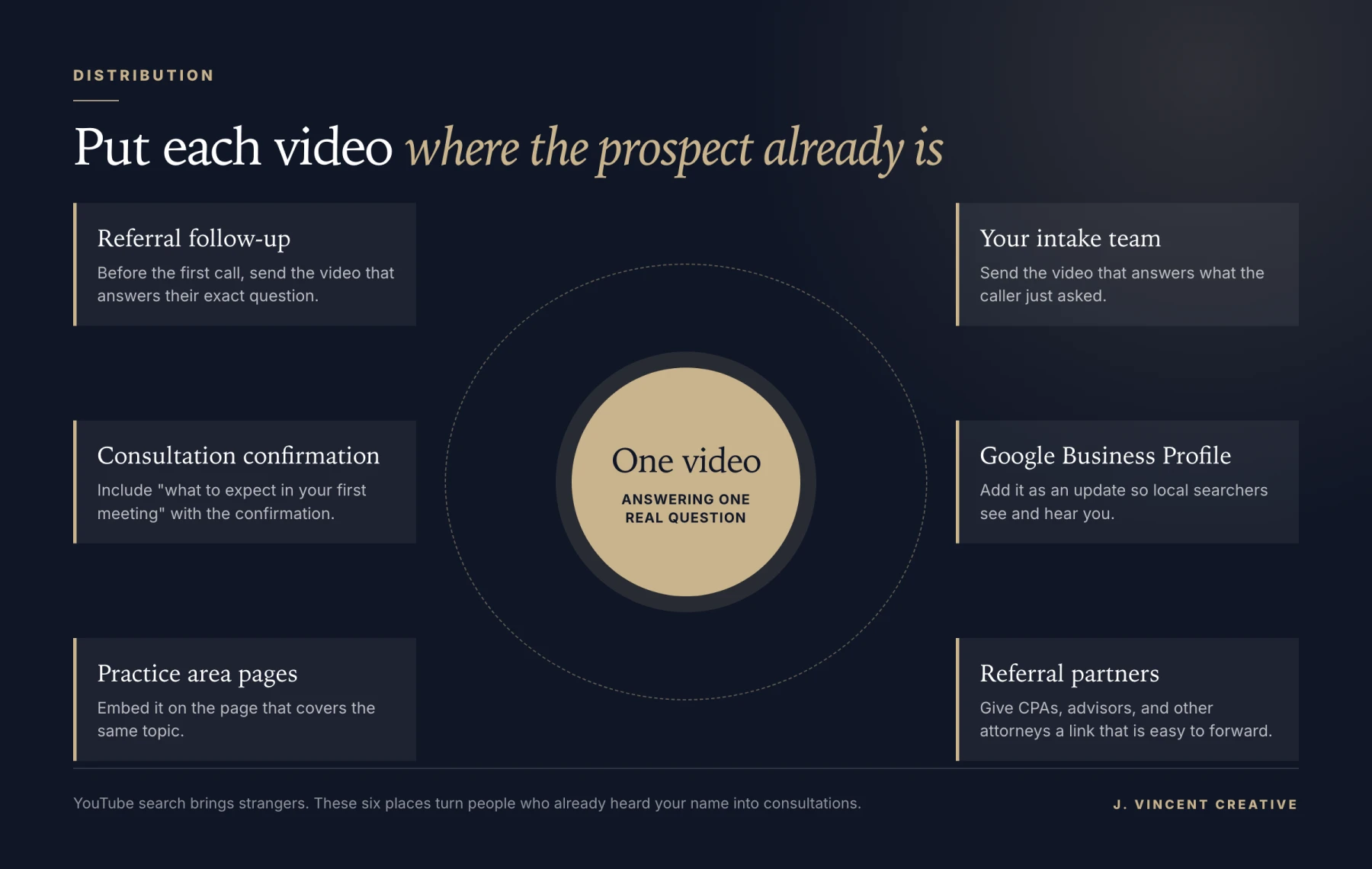
Use videos in the moments that matter
- After a referral. When a client or partner introduces someone, reply with the video that answers that person's likely first question. "Before we talk, this might help."
- Before the consultation. Send "what to expect in your first meeting" with the confirmation. Prospects show up calmer, with the right documents, and with better questions.
- From intake. Give your front desk a list of videos by question. When a caller asks how long a case takes, the follow-up email includes the video where you answer it.
- On your website. Embed each video on the practice area page that covers the same topic. Your fee video belongs on the page people read right before they call.
- With referral partners. CPAs, financial advisors, realtors, counselors, and attorneys in other practice areas refer more easily when they have something useful to send. A clear video on what happens in probate is easier to forward than your phone number.
Two rules keep this clean. You may not give referral partners anything of value for recommending you, outside the narrow exceptions in Rule 7.2 and your state's version. And the videos should go to people who asked or were introduced, never cold to someone you know just had a legal problem.
Calls to action that do not feel like selling
Inside the video, the best call to action is usually the next video. Inside the description, add one simple next step, such as a link to your contact page or a plain checklist of what to bring to a consultation. Keep the tone the same as the rest of the video. You are offering help, not chasing a case.
Watch. Why good referrals go cold before they ever call you. More on the J. Vincent Creative channel
How do you optimize a law firm video for YouTube search?
YouTube search works mostly on what the viewer typed and how people respond to your video once they click. So the basics matter more than tricks. Every video should ship with the same complete package.
- A title that uses the phrase people search, in their words, inside about 60 characters, with your state when the answer depends on it.
- A description whose first two lines answer the question plainly, followed by a short summary, the general-information line, your firm name and office location, and a link to your site. Mention the counties you serve.
- Chapters with clear labels, so viewers can jump to the part they need and YouTube can show those sections in search.
- Accurate captions. Upload a corrected caption file instead of relying on auto captions, which often mangle terms like nolo contendere, voir dire, and code section numbers.
- A pinned comment or end screen that points to the next video in the series.
- Playlists by stage or practice area, such as what to do after a wreck, the divorce process, or working with our firm, so one video leads naturally to the next.
- A custom thumbnail that passes the postage-stamp test.
Tags matter far less than most guides suggest. YouTube itself says they play a minimal role. Spend that time on the title and the first 30 seconds instead.
Your videos can also rank in Google, not just YouTube. Embed each one on the matching practice area page with a few paragraphs of supporting text, and add new videos as updates on your Google Business Profile. AI assistants increasingly cite pages and transcripts that answer legal questions directly, which is one more reason to say the answer plainly and early.
How long does it take to get cases from YouTube?
Plan on a year. Most firms that publish weekly start hearing "I watched your video" at consultations within the first few months, especially when intake and referral follow-ups use the videos. Search traffic from strangers takes longer to build, often six months or more, because YouTube needs time to learn who your videos are for.
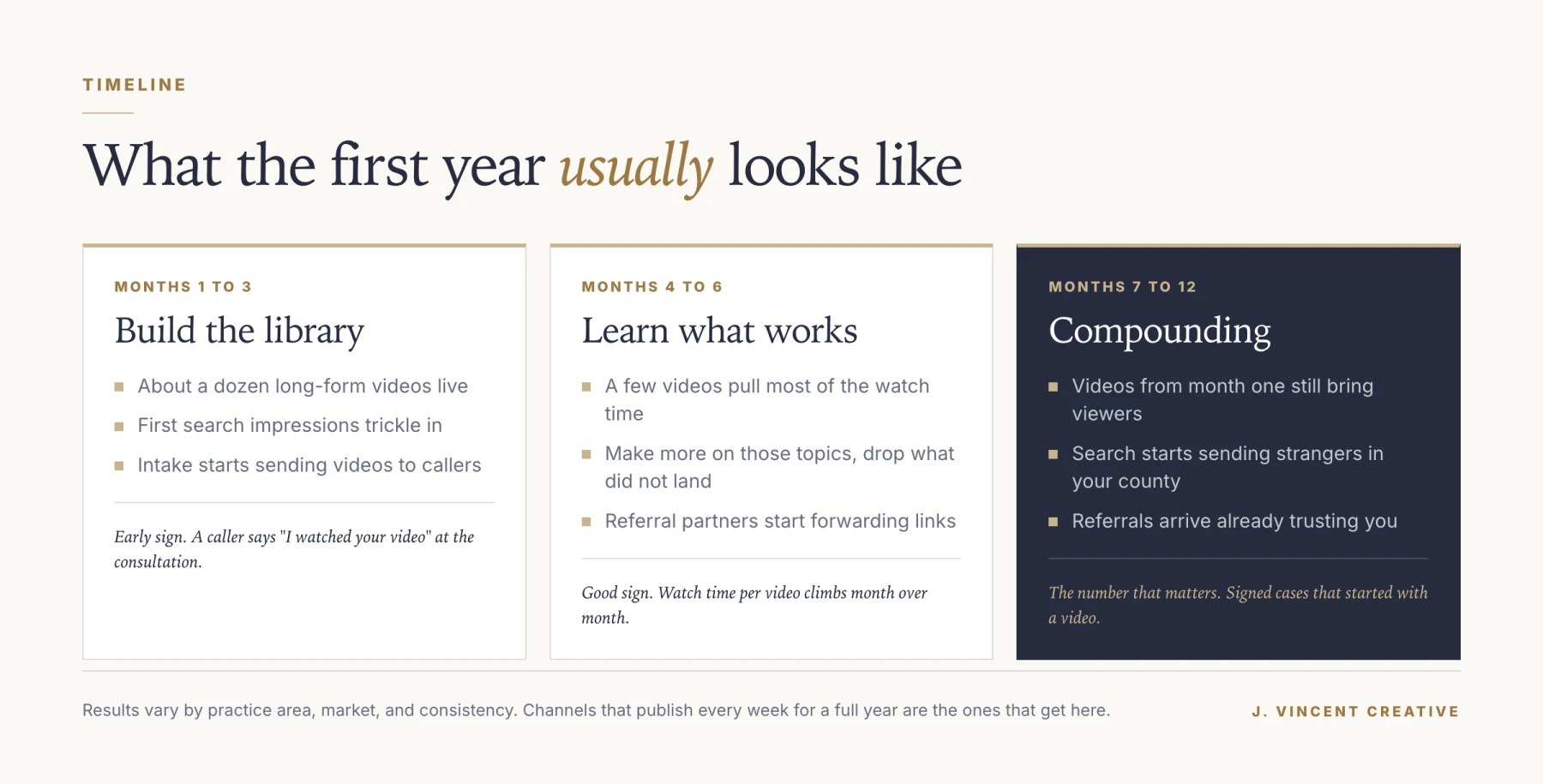
The library also keeps working long after you film it. The arraignment video mentioned earlier was posted in 2011 and is still being found. Pay-per-click stops the day the budget does. A clear explanation of what happens at a first court date keeps sending calls for years.
What to measure instead of views
Views are the wrong scoreboard for a law firm. A channel watched by a few hundred people in your county can sign more of the right cases than a legal entertainer with a million subscribers. Track these instead.
- Consultations that mention a video. Ask every new caller how they found you and what they watched. This is the number that matters most.
- Signed cases that started with a video. Put it next to what a signed case costs you from paid ads or lead services.
- Consultation quality. Do callers arrive already understanding your fees and process? Your intake team will notice first.
- Watch time per video. Which topics hold people longest tells you what to make more of.
- Click-through rate on thumbnails. If a good video is not getting clicked, the packaging needs work, not the content.
- Videos sent per month. How often your team used a video in a referral follow-up, intake email, or consultation confirmation.
Why do most law firm YouTube channels stall?
The pattern is predictable. A firm posts a burst of videos, gets a few nice comments from other lawyers, sees low view counts, and quietly stops around month three. Usually the cause is one of these.
- The videos are about the firm. Founding stories, team introductions, and "we fight for you" have their place, but they are not why a scared stranger clicks.
- They sound like a TV commercial. Shouting, urgency, and dramatic music make a firm look like every billboard on the interstate. Calm explanation is what stands out.
- The language is legalese. If a viewer needs a law degree to follow the first minute, they are gone by the second.
- There is no audience. A channel covering eight practice areas for everyone is a channel for no one in particular.
- Publishing is inconsistent. Four videos in January and none until May teaches YouTube nothing and teaches prospects you might not be there either.
- An attorney is doing the editing. It is the slowest, least valuable use of a lawyer's time and the most common reason channels stop.
- Ethics review is an afterthought. Filming first and reviewing later leads to reshoots, delays, and a partner who stops trusting the project.
- The videos never get used. A video that only lives on YouTube waits for strangers. A video your intake team sends every day works this week.
The channels that work are rarely the most polished. They are the ones that kept answering real questions, every week, for a year.
Should your firm do it yourself or hire help?
It depends on how much time you have and what your time is worth on billable work and in front of clients. Here is how the three common setups compare.
| Do it yourself | Freelance editor | Done-for-you agency | |
|---|---|---|---|
| Your time each month | Often 20 hours or more | About 8 to 12 hours | One filming session plus approvals |
| Topic research | You | You | Agency, with your input |
| Scripts | You | You | Written in your voice, you approve |
| Ethics review prep | You | You | Scripts formatted for review, and for filing where required |
| Editing and graphics | You | Editor | Agency |
| Titles, thumbnails, SEO | You | Usually you | Agency |
| Shorts | Rarely happens | Sometimes | Included |
| Best for | Attorneys who enjoy production and have time | Firms that can plan and write but not edit | Firms that want the result without becoming a media company |
If you hire an agency, look for one that knows law firms specifically. Ask how they handle bar advertising rules, whether they write the scripts or expect you to, who directs the filming, and how they measure success. If the answer is views and subscribers alone, keep looking.
Questions attorneys ask about YouTube
Is YouTube worth it for a law firm?
For most firms that serve a clear type of client, yes. The value is not ad revenue or fame. It is that prospects can watch you explain their situation before they call, so consultations start with trust. A small channel watched by the right people in your area can be worth more than a large general one.
Can attorneys advertise on YouTube?
Yes. Lawyer advertising is allowed in every state, subject to that state's version of the rules on false or misleading communications, required disclosures, and in some states filing or record-keeping. Educational videos that follow those rules are common. Your state's rules and ethics opinions decide the specifics.
Do attorney YouTube videos count as advertising?
Often, yes. A video that invites viewers to contact your firm is usually treated as an advertisement. A purely educational video may not be, depending on your state. New York's NYSBA Ethics Opinion 1251, for example, found an educational channel is not necessarily advertising. Many firms simply treat every video as an ad and include the required disclosures.
Does answering legal questions on YouTube create an attorney-client relationship?
General information for a public audience usually does not, but replies to individual viewers can blur that line. Say on screen and in the description that the video is general information, not legal advice, and does not create an attorney-client relationship. In comments, answer only in general terms and move specific questions to a private consultation.
Can I use client testimonials in my law firm videos?
In most states, yes, with care. A testimonial cannot create an unjustified expectation of results, many states require a disclaimer, and paid testimonials or actors portraying clients usually must be disclosed. Because a client is discussing their own matter, get informed consent in writing and route the video through ethics review before it goes live.
How often should a law firm post on YouTube?
Once a week is the most sustainable rhythm that still builds momentum. Consistency matters more than volume. One video every week for a year beats a burst of ten videos followed by silence.
How long should an attorney YouTube video be?
Most law firm long-form videos land between 8 and 12 minutes, which is about 1,200 to 1,600 scripted words. That is long enough to explain a process properly and short enough to hold someone who is stressed. Shorts should usually be 30 to 60 seconds.
What should a law firm's first YouTube video be?
Answer the question you hear at every intake, such as "will I lose the house" or "is this going on my record." Then make a plain-English video on how your fees work and one on what happens after someone hires you. Those three cover what a prospect needs before booking a consultation.
How many subscribers does a law firm channel need to get cases?
Far fewer than most people think. Small firm channels with a few hundred subscribers regularly have videos with tens of thousands of views, and many viewers who call were sent a video directly. Track consultations and signed cases that mention a video rather than subscriber counts.
Jeff Evans
Jeff Evans is the founder of J. Vincent Creative, a YouTube video marketing agency in metro Atlanta for attorneys, financial advisors, and other professionals who sell on trust. He plans, scripts, directs, and produces educational video that helps prospects trust a lawyer before the first call, and he is the person in the room on every client engagement.
This guide is general education about marketing. It is not legal advice or ethics advice. Lawyer advertising rules change and vary by state, and their application depends on your jurisdiction and your firm. Confirm any approach against your state's current rules of professional conduct, or with your state bar's ethics hotline, before publishing. J. Vincent Creative is not a law firm and does not replace your firm's own review.
Want this done for you?
Film once a month. Let the videos handle the first conversation.
J. Vincent Creative researches the questions your clients ask at intake, writes the scripts in your voice for ethics review, directs one filming session, and delivers four long-form videos and sixteen shorts every month.
Book a channel strategy callOnsite in metro Atlanta or virtual anywhere in the country. No pressure, just a conversation about your practice and what your clients are asking.

Jeff Evans is the founder of J. Vincent Creative, a YouTube video marketing agency in metro Atlanta for financial advisors, attorneys, CPAs, and EOS Implementers. He plans, scripts, films, and produces educational video, video podcasts, and ghostwritten newsletters that help prospects trust a firm before the first call. Jeff has spent his career in search and video marketing for professional service firms, and he is the person in the room on every client engagement.