
The complete guide for attorneys
YouTube marketing for attorneys, from first video to signed client
YouTube works for law firms when it answers the questions people type late at night, in plain language, before they ever call a lawyer. This guide covers the whole system. Who the channel is for, which videos to make first, how to title and script them, how bar advertising rules fit in, and how a video library turns into consultations that feel like second meetings.

 Most consultations now start at a kitchen table, hours before anyone calls the firm.
In this guide
- Does YouTube work for lawyers?
- Who your channel is for
- The first videos to make
- Finding topics people search
- Titles and thumbnails
- Scripts that hold attention
- Filming around a court calendar
- Bar advertising rules
- YouTube Shorts
- Turning viewers into clients
- YouTube SEO for law firms
- How long it takes
- Why channels stall
- Do it yourself or hire help
- Questions attorneys ask
Does YouTube actually work for attorneys?
Yes, when the goal is trust and signed cases rather than views. A law firm does not need a big channel. A few hundred of the right people in your area watching you explain the problem they are scared about is enough to change who calls and how the consultation goes.
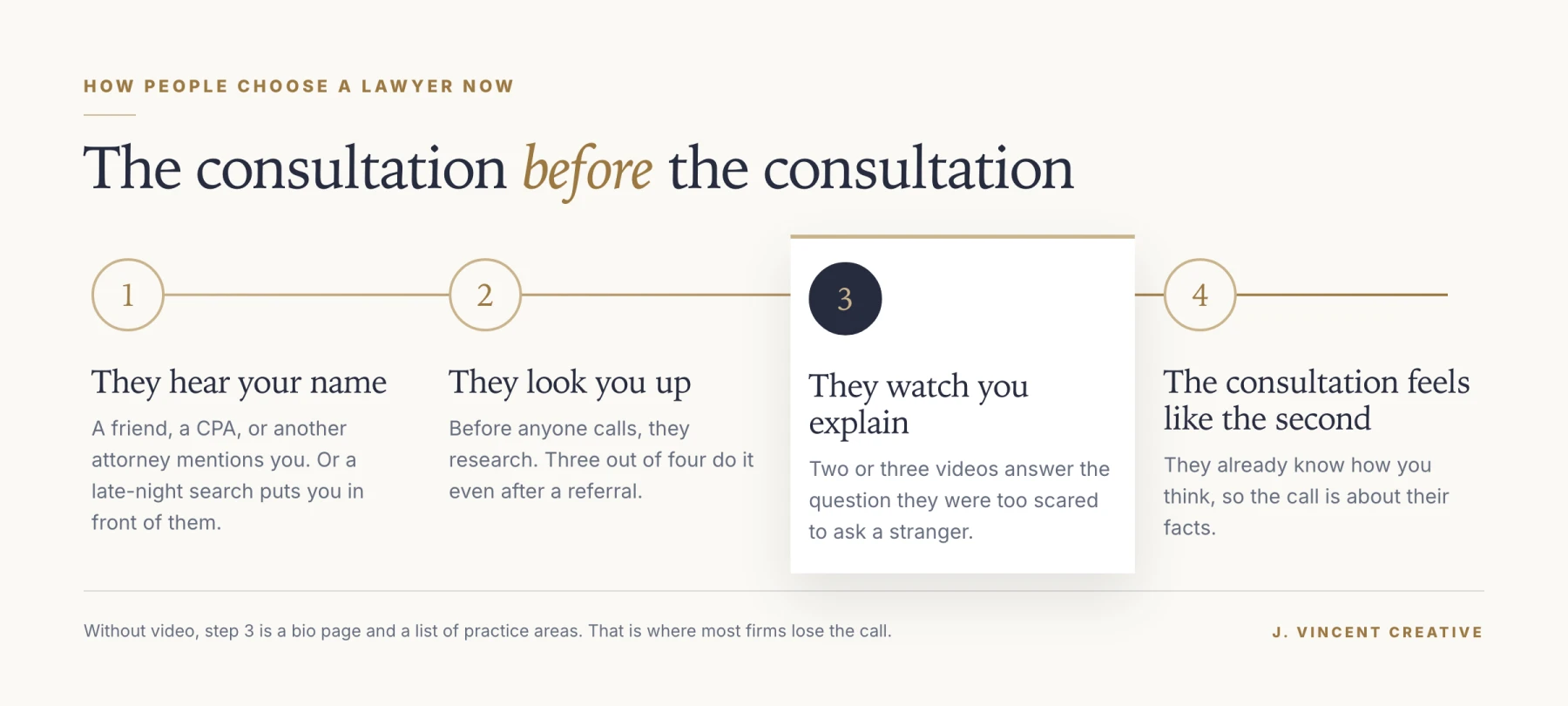
People still hire lawyers through referrals. What changed is what happens after the referral. Someone gets your name from a friend, a CPA, or another attorney. Then, before they call, they look you up. In Scorpion's 2025 survey of 3,000 U.S. adults, 75% said they would still check a lawyer out online before calling, even when referred. And 52% said they look for videos that explain a law firm's services before they decide.
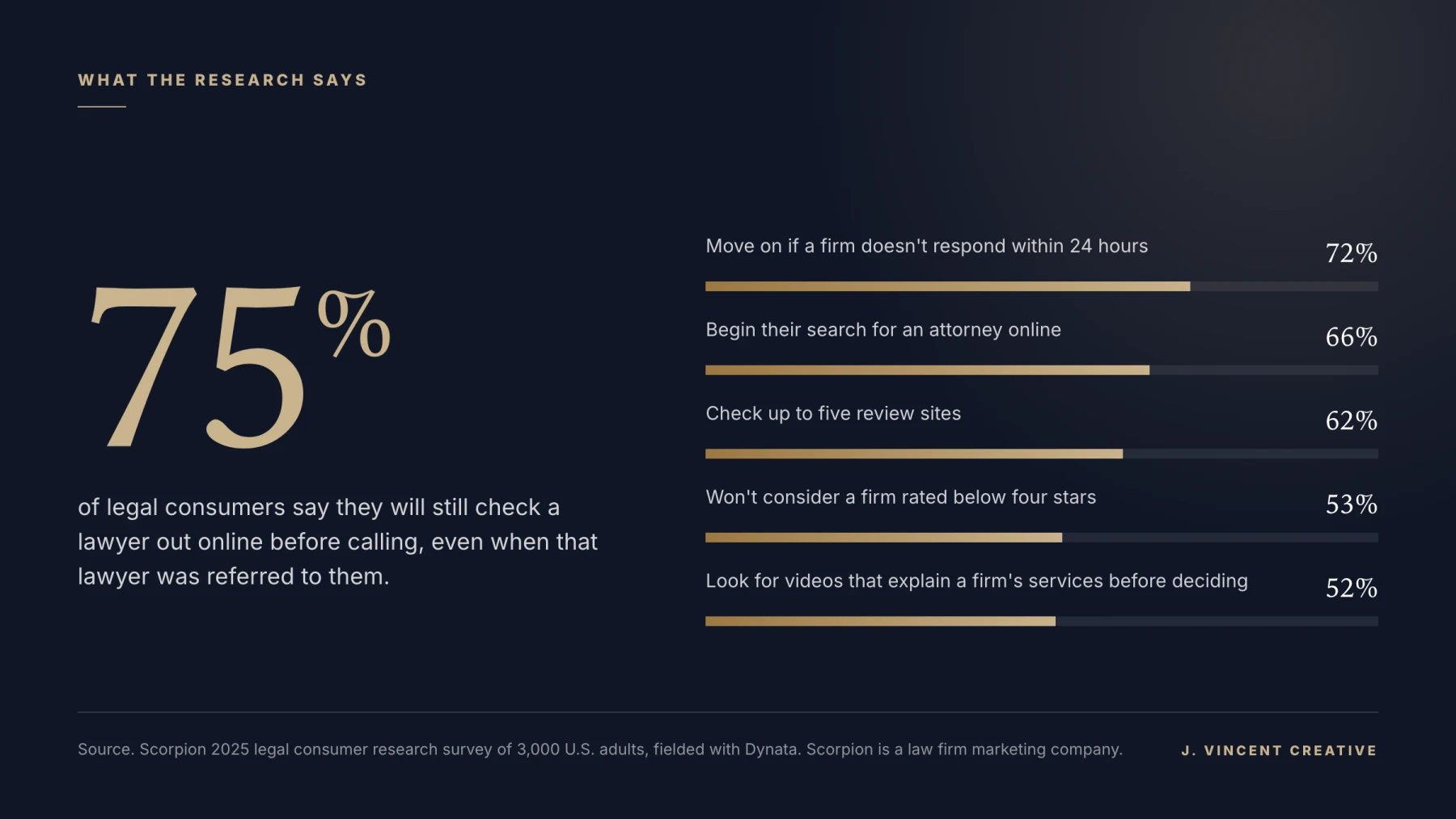
So the real question is what they find. For most attorneys it is a bio page, a headshot with crossed arms, and a list of practice areas. None of that lets a scared person hear how you explain things. A video does. Eight minutes of you calmly walking through what happens at a first court date tells a prospect more about whether they would trust you than any badge in your footer.
That is the job of a law firm's YouTube channel. It is the consultation before the consultation.
Anthonia Berry has spent 20 years in legal marketing and business development, including leadership roles at national and international firms. On my show she described what happened when she needed a corporate attorney herself. She was given a few names to research, so she went looking for what each of them had published.
"If they were talking about things that automatically answered some of the questions that I had, I already felt like they already had the answer." She had not paid anyone or booked anything yet. The videos had already done most of the deciding.
Something else is easy to miss with legal work. The person searching is often not the client. It is the mother whose son was arrested, the adult daughter sorting out a parent's estate, or the spouse who wants to understand a divorce before saying the word out loud. Video lets them hear you before anyone in the family has to make the call.
Video also re-introduces you to people who already know you. Former classmates, parents from your kids' teams, the couple from church. They know you as a person. Watching you explain what to do after a wreck is what makes them think of you when someone in their life gets hurt, served, or arrested.
Who should your firm's channel be for?
The most common reason a law firm channel never gets traction is that it covers every practice area for everyone. "People who need a lawyer" is not an audience. YouTube rewards channels that a specific viewer can recognize as being for them within a few seconds.
Start with the cases you most want more of. Then describe the person behind them in one sentence that names the moment they are in.
- Someone hurt in a wreck who just got the first call from an insurance adjuster.
- A parent whose teenager was arrested and who has never set foot in a courtroom.
- A spouse thinking about divorce who wants to know about the house and the kids before saying anything.
- Adult children handling a parent's estate, or trying to get a parent's plan in place before it is too late.
- A business owner about to sign a lease, take on a partner, or sell the company.
- Families in your county who would rather hire someone who knows the local courthouse.
A firm can serve several of these. The channel should lead with one. When a parent in Forsyth County finds a video about what happens after a juvenile arrest, from a lawyer who names the local court and explains the first hearing, the video feels made for them. That feeling earns the click, the watch, and later the call.
A quick test. Read your last five video titles to your intake person. If they would not say "people ask me that every week" about at least three of them, the channel is still talking to everyone.
Make every video about the viewer, not the firm. A prospect does not want your founding story, your verdicts, or the word "aggressive" first. They want to see their own situation explained by someone who clearly understands it. The lawyer is the guide in the video, never the subject. A useful check is to count how often your script says "you" compared with "I" or "we." Aim for three to one.
Anthonia Berry of Strategy Academy on picking a lane, referrals, and talking about pricing on video
What videos should a law firm make first?
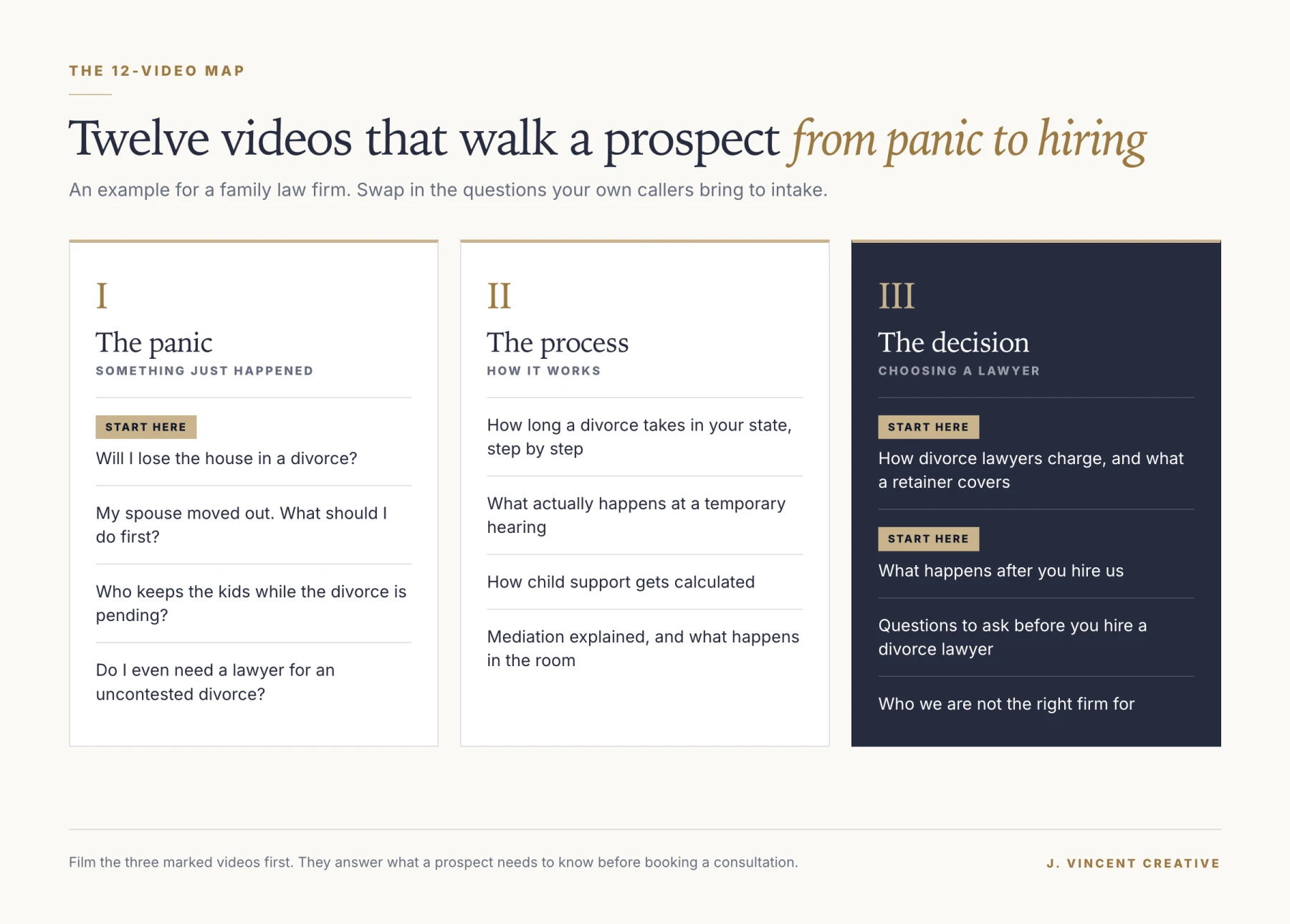
Make the videos a prospect needs before they are willing to pick up the phone. That means mapping videos to the three stages a person moves through on the way to hiring a lawyer.
- The panic. Something just happened. An arrest, a wreck, divorce papers, a death in the family. They want to know what happens next and what not to do.
- The process. They try to understand how it works. How long it takes, what each hearing is for, what the other side will do.
- The decision. They compare lawyers. How do you charge? What happens after they hire you? Are you the right firm for someone like them?
Four videos per stage gives you twelve, which is about three months of weekly publishing and a library that carries a prospect from fear all the way to a signed engagement letter.
The three to film first
If you only make three videos this quarter, make these.
- The question you answer at every intake. For a family lawyer it might be "will I lose the house." For a defense lawyer, "is this going on my record." Answer it the way you would in your office, with the honest "it depends" and what it depends on.
- How your fees work, in plain English. Contingency, flat fee, hourly, or retainer. A personal injury firm can explain exactly how it gets paid and what the client might still owe. A family law firm can give honest ranges and explain what moves a case from one end to the other. Prospects who understand your fees before the consultation do not go quiet when the engagement letter shows up.
- What happens after you hire us. Who they talk to, what happens in the first two weeks, how often they will hear from you, and how long each stage usually runs. This one video removes most of the fear of the first call.
Two of those three sit in the decision stage on purpose. These are the videos you send to people who already have your name, and they turn into consultations faster than anything else you make.
My family learned this the hard way choosing coaches for my son. When he was ten, he was put with football coaches who cursed at the kids, and he came home crying. We never asked a single question before he started.
Now we ask every coach the hard questions face to face. How do you teach? Do you yell? Is this about winning, or are you developing my son? Most of your prospects will never ask a lawyer the version of that. They are too polite or too scared to ask "what will this cost" and "what am I walking into." Your fee video and your process video ask it for them.
How do you find video topics people actually search for?
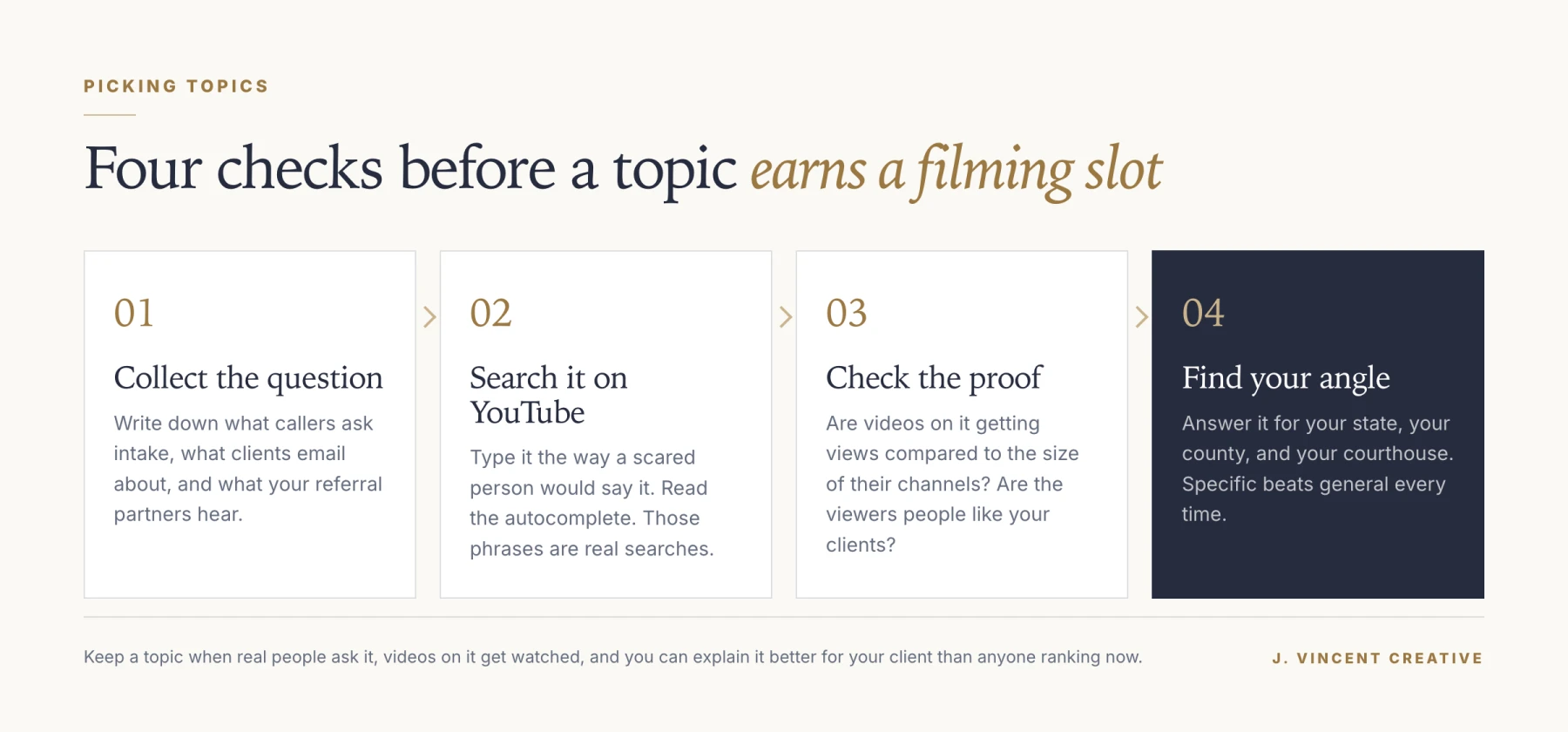
The best topics are already sitting in your intake notes. Every question a caller asks the front desk, every email a client sends at midnight, and every "quick legal question" at a birthday party is a video idea. Ask your intake team for the ten questions they answer most and start there.
Then check each question against real demand before you film it. Guessing is how firms end up with forty videos about statutes nobody searches for.
How to check demand in ten minutes
- Type the question into YouTube the way a scared person would say it. "What happens at an arraignment," not "arraignment procedure." Watch the autocomplete suggestions. Those are phrases real people searched.
- Look at the top results. Compare each video's views with the size of the channel. When we checked in October 2026, a small criminal defense firm with about 250 subscribers had an arraignment video with more than 53,000 views. A personal injury firm with about 660 subscribers had more than 57,000 views on "how long does a personal injury case take." That is proof the topic pulls viewers on its own.
- Check who those videos serve. If the top results are law students or a national audience, the phrase may be right but the viewer is wrong. Find the version your clients would type, often with your state or county in it.
- Decide your ang